
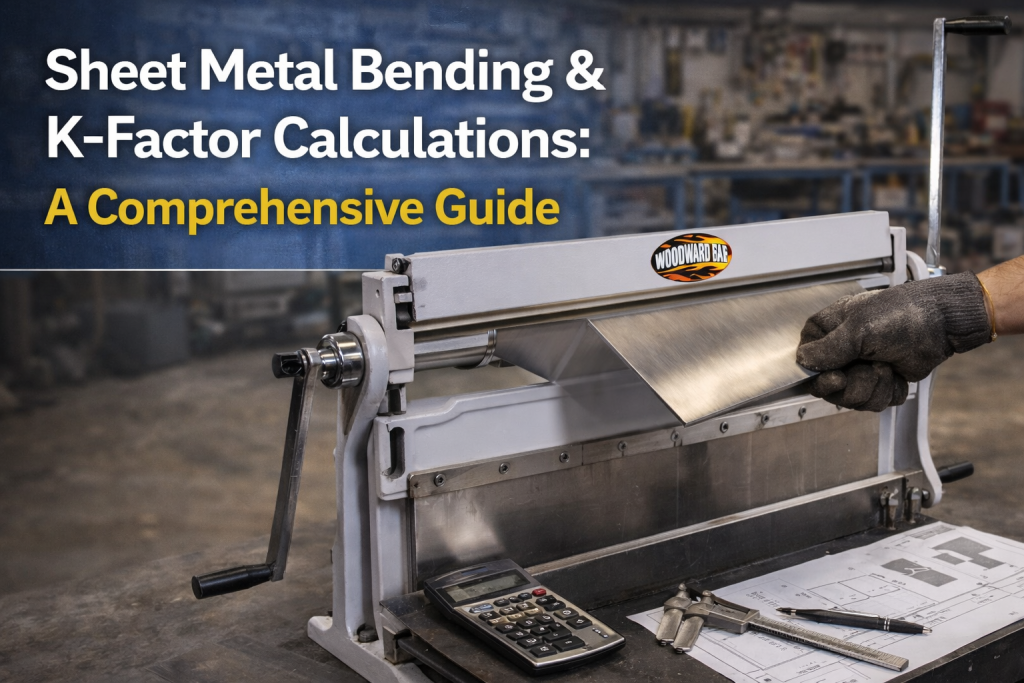
Sheet metal bending is a fundamental process in metal fabrication, where metal sheets are shaped using force to create precise angles and geometries. This versatile technique transforms flat sheets into complex parts, making it essential across industries such as automotive, aerospace, and construction where precision is crucial. However, achieving accuracy in sheet metal bending is vital, especially when working with intricate designs. Even small errors in bend allowances or angles can lead to parts that don’t fit or function properly. Understanding how materials behave during bending and accurately calculating bend allowances is key to producing cost-effective, high-quality components. The K-factor, a ratio that defines the position of the neutral axis within the sheet’s thickness, plays a crucial role in ensuring bends match the required dimensions. In this post, we’ll explore different sheet metal bending techniques, the K-factor and how to calculate it, factors influencing its value, tools and software used in bending calculations, and common mistakes to avoid for more efficient and precise sheet metal fabrication.
Types of Sheet Metal Bending Techniques
There are several types of bending techniques used in sheet metal fabrication. Each method has its advantages depending on the material, desired bend angle, and complexity of the part.
- Air Bending: This is one of the most commonly used techniques, wherein the sheet metal is placed over a die, and a punch applies force to the material. The metal does not make direct contact with the die, leaving a gap or air between the die and the material. The material is bent to the desired angle by the punch. This technique is popular owing to its simplicity and flexibility. It is especially effective for creating shallow bends with low to medium radii.
- Bottoming: In bottoming, the punch is pressed into the die to form a bend. The sheet metal makes full contact with the die at the bottom of the bend. This method provides more precise bends, especially for thicker materials. Bottoming is commonly used for applications that require high-precision bends, such as in the production of structural components in automotive and aerospace manufacturing.
- Coining: Coining is a more precise bending technique that involves pressing the sheet metal into a die with high force. The punch and die used in coining are designed for tight tolerances, making it ideal for applications that require very sharp angles or high accuracy. Coining is typically used in situations where precise, repeatable bends are essential, such as in the creation of intricate parts for electronic devices or medical equipment.
Why Precision in Bending Matters and How the K-Factor Helps
Accurate bending is essential in sheet metal fabrication to ensure parts fit properly in assemblies and meet design specifications. Even small errors in bend angles or dimensions can lead to poor fits, weak structural integrity, or compromised performance, especially in industries such as automotive, aerospace, and construction.
To achieve precision, it’s important to understand how materials behave during bending. Factors such as material thickness, type, and bend radius influence the material’s deformation. This is where the K-factor comes in. It helps determine how much the material stretches or compresses, allowing for accurate bend allowance calculations. A K-factor of 0.5 indicates the neutral axis is at the center, while values below or above 0.5 show shifts toward the inside or outside of the bend, respectively.
K-Factor Formula and Formula Breakdown
The K-factor is defined as the ratio of the distance from the inside surface of the bend to the neutral axis (t), divided by the total material thickness (T):
K = t / T
Where:
K is the K-factor (a dimensionless ratio, typically between 0.25 and 0.50 for most sheet metals and bending conditions)
t is the distance from the inside surface of the bend to the neutral axis
T is the total thickness of the material
In practice, t is not measured directly. Instead, it is determined through empirical testing, material data, bend tooling conditions, or CAD/CAM software values based on factors such as:
- material type and temper
- material thickness
- inside bend radius
- tooling and bending method (air bending, bottoming, coining)
Once the neutral axis location is known or estimated, calculating the K-factor becomes straightforward.
Bend Allowance Formula
The K-factor feeds into the bend allowance (BA) formula, which calculates how much material length is consumed by the bend:
BA = (π / 180) × (R + K × T) × A
Where:
R is the inside bend radius
A is the bend angle in degrees
T and K are as defined above
Together, these formulas allow you to calculate the correct flat blank size so that your finished part matches the intended dimensions after bending.
How to Calculate K-Factor (Step-by-Step)
Here’s how to determine the K-factor for a given material and bend scenario:
- Measure material thickness (T): Use a calibrated gauge to measure the sheet thickness. Ensure the measurement is consistent across the part as variations will affect accuracy.
- Determine the inside bend radius (R): This is the radius formed at the inside edge of the bent sheet. It is primarily influenced by tooling geometry, especially punch radius and die opening.
- Find the neutral axis distance (t): This value is typically not measured directly. Instead, it is derived from empirical bend data, industry reference charts, bend test results, or CAD/CAM software based on the material type, thickness, bend radius, and tooling conditions. It represents the location of the neutral axis within the material under specific bending conditions.
- Apply the K-factor formula: Divide t by T to get your K-factor, then use it in the bend allowance formula to determine the correct flat blank length.
Example:
A mild steel sheet with the following properties:
- Material thickness (T) = 0.25 inches
- Inside bend radius (R) = 0.5 inches
- Neutral axis distance (t) = 0.113 inches (from material specification table)
K-factor = t / T = 0.113 / 0.25 = 0.45
This result of 0.45 is typical for mild steel with a moderate bend radius, indicating that the neutral axis sits slightly inside the sheet’s center, closer to the outer surface, which is the expected behavior during bending.
Factors Affecting K-Factor
Several factors influence the value of the K-factor in sheet metal bending. Understanding these factors can help manufacturers achieve more accurate results.
- Material Type: Different materials behave differently during bending due to variations in ductility, yield strength, and elasticity. Materials such as aluminum typically exhibit slightly higher K-factors than many steels under similar bending conditions because they stretch more easily. Material grade and temper can also influence the final value.
- Bend Radius: The bend radius significantly affects the K-factor. Smaller bend radii generally produce lower K-factors because the neutral axis shifts closer to the inside surface during tighter bends. Larger bend radii tend to move the neutral axis closer to the material centerline, resulting in higher K-factor values.
- Bend Angle: While bend angle does not directly change the K-factor itself, larger bend angles increase the total deformation occurring in the material. This makes accurate K-factor selection more important, as small calculation errors become more noticeable in parts with larger bend angles.
- Material Thickness: Material thickness influences how the neutral axis shifts during bending. As sheet thickness increases under similar tooling conditions, the neutral axis often moves slightly toward the inside surface of the bend, which can result in lower K-factor values. Thickness must therefore be considered alongside bend radius and tooling setup.
- Bending Method and Tooling: Air bending, bottoming, and coining each produce different amounts of material deformation, resulting in different K-factors for the same material. Tooling geometry, including punch tip radius, die opening width, and tooling condition also plays a critical role. Always validate K-factor values against your actual equipment and bending process.
Tools and Software Used in Bending Calculations
Various tools and software help support accurate bending calculations by integrating K-factor values into the production workflow.
- CAD Software: CAD programs allow designers to model sheet metal parts and generate flat patterns. These programs often include built-in tools that automatically calculate K-factors based on the material, bend radius, and thickness, helping reduce human error during the design phase.
- CAM Software: CAM software integrates with CAD systems and prepares the design files for manufacturing. These programs consider material properties, tooling, and bending parameters to calculate K-factors, allowing fabricators to plan and optimize the bending process for better efficiency and precision.
- Bend Simulation Tools: Specialized simulation software models the bending process to predict real material behavior. By accounting for factors such as stretching, springback, and tooling interaction, these tools help refine bend allowances and improve the accuracy of K-factor assumptions.
- K-Factor Calculation Tools: Dedicated K-factor calculators, either as standalone applications or integrated within CAD/CAM systems, are widely used for accurate bend allowance predictions. These tools take into account material type, thickness, bend radius, and angle to determine the ideal K-factor, reducing manual calculations and improving consistency.
- FEM (Finite Element Method) Analysis Software: FEM analysis tools provide advanced simulations of stress and strain during bending operations. These simulations offer detailed insights into neutral axis movement and material deformation, allowing manufacturers to fine-tune K-factor values for high-precision applications.
In practice, K-factor values are often validated through shop-floor testing and adjusted empirically to match specific materials, tooling, and machine conditions.
Common Mistakes to Avoid When Calculating K-Factor
While calculating the K-factor is crucial for ensuring accurate sheet metal bending, several common mistakes can lead to errors in the final part dimensions. Here are some of the most frequent pitfalls to avoid.
- Using the Wrong Formula for Your Bend: Different types of bends, like air bends or bottoming, may require different formulas for the K-factor calculation. Using the wrong formula can result in dimensional inaccuracies that affect the fit and functionality of the part.
- Not Accounting for Tooling Factors: The K-factor can be influenced by the tooling used in the bending process. For example, the type of die or punch used can impact the final result. If tooling characteristics aren’t considered, it may lead to incorrect calculations.
- Relying on generic K-factor tables without validation: Standard K-factor tables are a useful starting point, but they don’t account for the specific characteristics of your material lot, your tooling, or your machine. Always validate tabulated values against test bends on your actual setup.
- Neglecting Springback Effects: After bending, materials tend to spring back slightly, affecting the final shape. Not accounting for springback in your calculations can lead to overcompensation, resulting in an incorrect final part.
- Lack of Regular Calibration: Not regularly calibrating your equipment or bending machines can lead to variations in bending accuracy. Machine calibration affects the consistency of each bend, impacting the overall reliability of your K-factor calculations.
Getting the Right Results Starts with the Right Tools
Accurate K-factor calculation is the foundation of precise sheet metal bending. It determines your flat blank size, informs your bend allowance, and ultimately dictates whether your finished parts come out to spec. But calculations alone only get you so far. Turning those numbers into accurate physical parts requires reliable, well-built bending equipment. At Woodward Fab, we offer a range of sheet metal fabrication tools including benchtop budget brakes, 3-in-1 sheet metal machines, press brakes, form benders, and box and pan bending brakes for fabricators who need dependable, repeatable results.
Get in touch with the team at Woodward Fab today to find out which tools best match your bending requirements.

Related Post:
- How to Read a Sheet Metal Gauge Chart: Gauge, Thickness & Material Explained
- Why Does Sheet Metal Crack When Bending? Causes and Solutions
- Manual vs Hydraulic Press: Which Metal Fabrication Press Do You Need?
- Sheet Metal Holders: Types, Benefits, Applications, and Buying Guide
- Sheet Metal Bending Rules: Complete Guide to Design, Radius, and Best Practices