
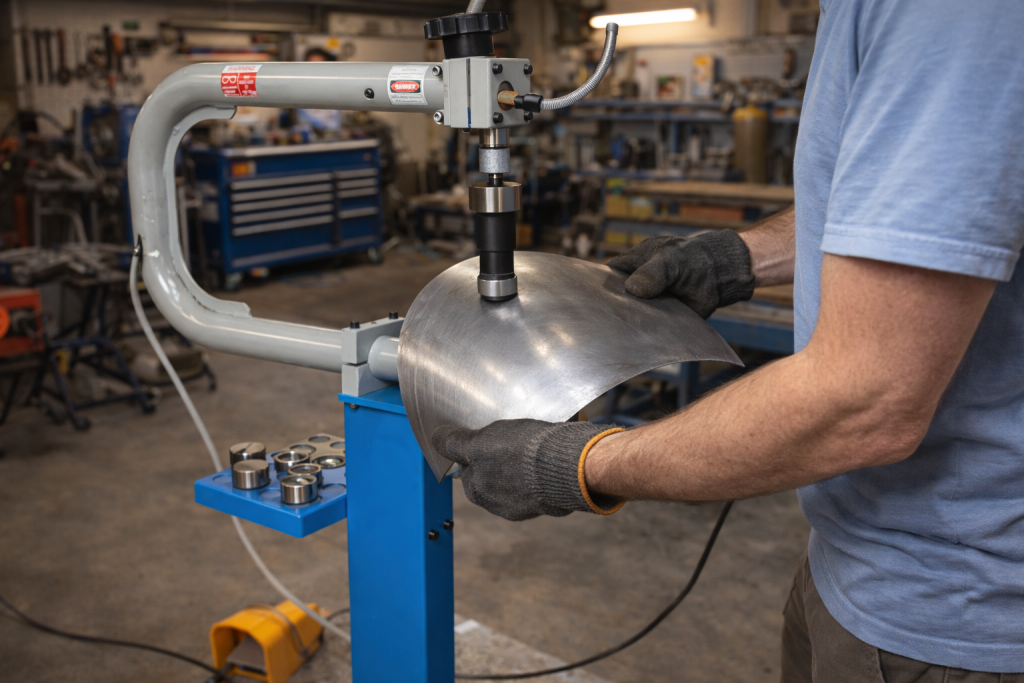
Choosing between industrial and hobby metal fabrication tools is a common decision for fabricators, repair technicians, and workshop owners. Hobby tools are typically designed for lighter tasks and occasional projects, while industrial equipment is built for demanding applications, tighter tolerances, and continuous operation. This often raises a common question: can hobby-grade tools handle serious fabrication work, or are industrial tools necessary for professional results? The answer largely depends on workload, application, and performance expectations. In this guide, we explore industrial vs hobby metal fabrication tools, highlighting their key differences, typical applications, and how to choose the right equipment for your shop requirements.
What are Industrial Metal Fabrication Tools
Industrial metal fabrication tools are built for high-output environments where precision and reliability are critical. These tools are used in manufacturing plants, structural steel shops, shipyards, and automotive production lines, operating across continuous shifts while maintaining consistent performance. Each cut, bend, and weld must deliver repeatable tolerances across large production batches.
What makes them essential is operational reliability. In production environments, downtime directly affects output and revenue. Industrial tools are therefore supported by commercial warranties, readily available replacement parts, and established technical service networks. For facilities producing components at scale, the right industrial tooling is not simply an upgrade but a fundamental operational requirement.
What are Hobby Metal Fabrication Tools
Hobby metal fabrication tools are designed for individual users, small workshops, and custom builders working at a low volume or personal scale. They offer practical precision without the footprint, power requirements, or cost of industrial equipment. These tools are commonly found in home garages, makerspaces, and vocational training environments where flexibility and ease of use matter more than production throughput.
Hobby tools are not inherently low quality. Many deliver clean, accurate results when used within their intended material thickness and duty cycle. They are simply designed for lighter workloads and intermittent use rather than continuous operation. For projects such as building a custom roll cage, fabricating decorative metalwork, or prototyping new designs, a well-chosen hobby tool can complete the job effectively without requiring large investments in space or equipment.
Industrial vs. Hobby Metal Fabrication Tools: A Side-by-Side Comparison
Evaluating industrial vs hobby metal fabrication tools helps fabricators make smarter, better-informed purchasing decisions. The table below highlights the factors that matter most in real-world use.
| Parameter | Industrial Tools | Hobby Tools |
| Build Quality | Heavy-duty construction with industrial-grade components for long service life. | Lighter builds with consumer-grade parts for occasional, low-intensity tasks. |
| Power Output | High power output capable of handling demanding fabrication tasks and thicker materials. | Lower power ranges suited for lighter gauges and smaller fabrication projects. |
| Cost Range | Higher upfront investment reflecting professional durability, capacity, and long-term reliability. | More affordable pricing accessible to individual users, hobbyists, and small workshops. |
| Accuracy level | Delivers consistent precision and repeatability, critical for production work and tight-tolerance assemblies. | Provides adequate accuracy for small projects but may require more manual adjustments during detailed or repeated work. |
| Maintenance needs | Requires scheduled maintenance, lubrication, and inspection to maintain performance under continuous use. | Requires less frequent maintenance due to lighter usage and intermittent operation. |
Applications of Industrial Metal Fabrication Tools
Industrial fabrication equipment is used across multiple industries where accuracy, durability, and continuous operation are essential. The following applications reflect typical production environments where industrial fabrication tools play a critical role.
- Automotive manufacturing: Industrial fabrication tools are used to produce body panels, chassis components, brackets, and structural parts where repeatable accuracy is required. These machines support long production runs while maintaining dimensional accuracy and consistent surface finish.
- Pharmaceutical equipment fabrication: Industrial fabrication shops manufacture stainless steel tanks, support frames, and structural components used in sanitary processing systems, including magnetic mixers and pharmaceutical tank assemblies. Industrial tools ensure clean weld preparation, precise forming, and consistent fabrication standards required for hygienic equipment.
- Food processing equipment manufacturing: Industrial fabrication tools are used to build frames, housings, and processing units for food-grade machinery. These components often support mixing systems, processing tanks, and other equipment that must meet strict hygiene and sanitation requirements.
- Heavy equipment and construction parts: Large structural parts, brackets, and reinforced frames require strong fabrication machines that can operate for long periods. Industrial tools provide stability required for consistent cutting, bending, and forming operations in fabrication shops.
Applications of Hobby Metal Fabrication Tools
Hobby fabrication tools also play important roles in professional environments, particularly in repair work, prototyping, and custom fabrication where flexibility matters more than production capacity. In many fabrication shops, hobby metal fabrication tools are used alongside industrial metal fabrication equipment to handle smaller tasks, quick modifications, and one-off projects.
- Prototype development shops: Small fabrication tools are useful for testing new designs, adjusting parts, and preparing samples before full production. Hobby equipment allows quick changes without setting up large industrial machines.
- Maintenance and repair workshops: Repair technicians often use hobby fabrication tools for quick fixes, bracket making, and part adjustments. These tools are easier to handle and work well for occasional fabrication tasks.
- Laboratory and process testing setups: Small fabrication tools are often used while installing test equipment such as magnetic mixers, compact industrial magnetic mixer units, or small assemblies supplied by a magnetic mixer supplier during experimental work.
- Custom fabrication and restoration work: Restoration shops and custom builders prefer hobby fabrication tools for detailed shaping, trimming, and modification work. These tools allow better control during one-off projects where production speed is not required.
How to Choose the Right Metal Fabrication Tool for Your Requirement
Choosing industrial vs hobby metal fabrication tools ultimately depends on how carefully you assess your production needs, available workspace, and long-term goals. Here are the key factors to evaluate before committing to a purchase.
- Assess Your Production Volume: High-quantity, regular fabrication work calls for industrial tools. For occasional builds or low-frequency projects, a well-specified hobby tool handles the workload without unnecessary overhead or cost.
- Match the Tool to Your Material Needs: Consider the thickness and type of material you work with most. Industrial tools manage heavier stock and tighter tolerances, while hobby tools perform reliably on lighter gauges and standard tasks.
- Evaluate Your Workspace and Power Supply: Industrial equipment often requires dedicated electrical service and floor space that a home workshop may not support. Hobby tools are generally designed for standard residential or small commercial setups.
- Factor in Long-Term Cost of Ownership: Industrial tools carry higher upfront costs, but their durability and lower maintenance frequency justify that investment for production environments. Hobby tools offer a practical balance for lower-volume use.
FAQs
- Are hobby-grade press brakes accurate enough for light structural applications?
Higher-spec hobby press brakes can provide adequate bending accuracy for light-duty fabrication tasks and small structural components when used within their material and tonnage limits. However, for tight tolerances, thicker materials, or repeat production runs, industrial press brakes with CNC controls and back-gauge systems are the more appropriate choice.
- How does cut quality differ on thicker plate when using plasma cutters in industrial vs hobby metal fabrication tools?
Industrial plasma cutters provide higher amperage, faster travel speeds, and more stable arcs, producing cleaner edges with minimal dross on thick plate. Hobby plasma cutters perform well on thinner materials but require slower cutting speeds on heavier stock and typically produce more dross or edge bevel, which may require additional post-cut finishing.
- How does consumable life compare between industrial and hobby fabrication equipment?
Industrial fabrication equipment is designed for stable, continuous operation, which helps maintain consistent cutting parameters and can extend the life of consumables such as blades, inserts, and electrodes. Hobby machines can deliver similar consumable life during light or intermittent use, but when operated for extended periods, consumables may wear faster due to lower duty cycles and lighter machine construction. Factoring consumable usage into the total cost of ownership is important when comparing equipment types.
- Can a hobby fabrication setup be scaled into a light production environment without replacing all equipment?
Some hobby tools support light production with careful scheduling, but duty cycle limits create bottlenecks. A phased upgrade approach, replacing the highest-demand tools first, is typically the most practical path forward.
- How does scrap and rework cost factor into choosing between industrial and hobby fabrication tools?
Industrial fabrication tools justify their higher cost by delivering tighter tolerances and better repeatability, which helps reduce scrap and rework in high-volume production environments. In lower-volume or custom fabrication work, hobby tools can be cost-effective when minor tolerance variation is acceptable, and parts do not require strict repeatability.

Related Post: