
Metal tubing plays a critical role in many industrial and mechanical systems, and copper tubing remains one of the most widely used materials due to its durability, corrosion resistance, and excellent thermal conductivity. It is commonly used in plumbing networks, HVAC installations, refrigeration systems, and automotive applications where reliable fluid transfer and efficient heat exchange are essential.
Working with copper tubing requires precision at every stage of fabrication. Processes such as straightening, cutting, bending, flaring, and joining must be performed accurately to ensure proper fit, leak-free connections, and long-term reliability. This is why professionals rely on specialized workshop tools designed specifically for copper tube fabrication.
This guide outlines the essential tools used in copper tube processing and installation, helping technicians and fabricators understand how the right equipment improves efficiency, accuracy, and overall workmanship.
Core Tools Required for Copper Tube Fabrication
Copper tube fabrication involves several stages, including preparation, forming, cutting, finishing, and installation. Each stage requires specialized tools that ensure the tubing maintains its structural integrity while meeting the dimensional requirements of the system.
The following tools are widely used by professionals to achieve consistent, high-quality results when working with copper tubing.
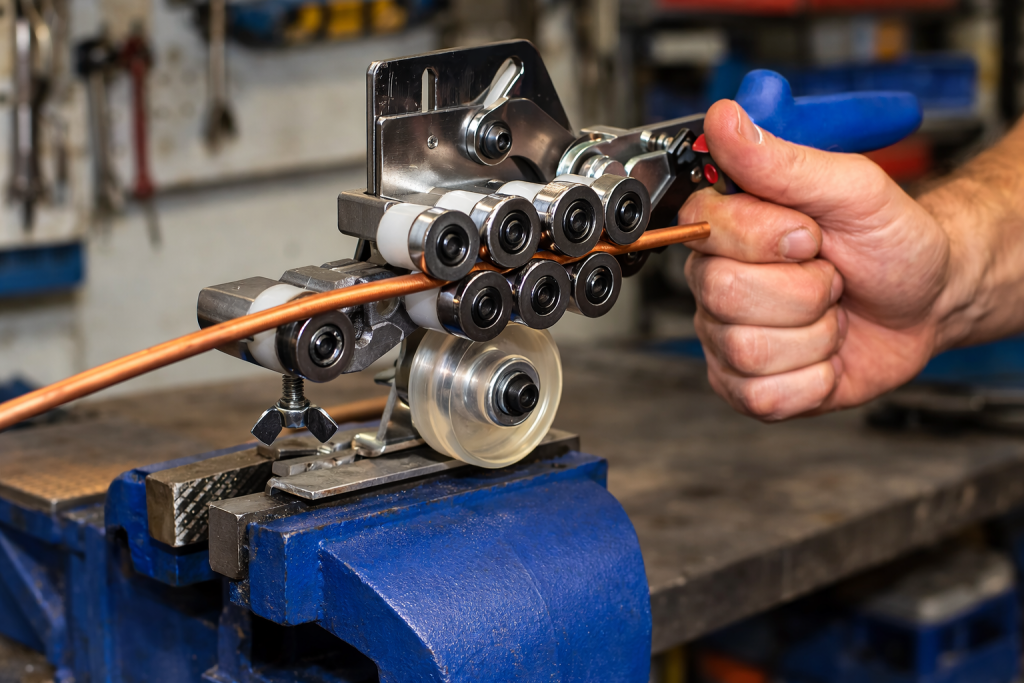
- Copper Pipe Straightener: Before performing operations such as bending or cutting, copper tubing must be properly aligned. A copper pipe straightener removes bends and distortions from coiled tubing, restoring it to a straight, uniform shape.
Straight tubing allows for accurate measurements and ensures that fittings align correctly during installation. This step also reduces unnecessary stress on joints, which helps prevent long-term reliability issues.
Key Advantages
- Improves measurement accuracy and alignment
- Reduces time spent manually correcting tubing
- Minimizes the risk of misaligned fittings and weak joints
- Copper Tube Bender: A copper tube bender allows technicians to form precise bends without collapsing or damaging the tube walls. Controlled bending is essential when routing tubing through confined spaces or when specific angles are required for installation. Proper bending tools help maintain the internal diameter of the tube, ensuring that fluid flow remains unobstructed.
Common Types of Copper Tube Benders
- Manual tube benders: Suitable for smaller tubes and field installations
- Hydraulic tube benders: Ideal for larger tubes and high-volume workshop applications
Using a dedicated copper tube bender ensures consistent bend angles while maintaining the structural integrity of the tubing.
- Copper Pipe Cutter: A copper pipe cutter is designed to produce clean, accurate cuts while minimizing tube deformation. Unlike saws, pipe cutters rotate around the tubing, gradually cutting through the material and leaving a smooth edge. Clean cuts are critical when preparing tubing for fittings, soldered joints, or flared connections.
Key Features to Consider
- Adjustable cutting wheel for multiple tube diameters
- Ergonomic handle for better control and comfort
- Replaceable blades for long-term performance
Using a high-quality copper pipe cutter ensures consistent pipe preparation and helps maintain installation accuracy.
- Copper Flaring Tool: A copper flaring tool forms a flared end on the tube, allowing it to connect securely with compatible fittings. This process is commonly used in refrigeration systems, HVAC installations, and gas lines where strong mechanical connections are required.
The flaring process expands the end of the tube into a cone shape that seals tightly against the fitting surface.
Types of Copper Flaring Tools
- Bar-type flaring tools: Suitable for standard manual applications
- Yoke-type flaring tools: Provide greater control and uniform results
A reliable copper flaring tool ensures precise flare geometry, which is essential for leak-free connections.
- Copper Tube Deburring Tool: After cutting or flaring copper tubing, sharp edges and burrs may remain along the tube surface. A copper tube deburring tool removes these irregularities and prepares the tubing for assembly. Deburring is an important finishing step because rough edges can interfere with fittings and restrict fluid flow.
Benefits of Using a Copper Tube Deburring Tool
- Ensures smooth surfaces for proper sealing
- Improves system performance by removing internal obstructions
- Enhances safety by eliminating sharp metal edges
Proper deburring contributes to reliable connections and consistent system performance.
- Copper Tube Support Clamps: During installation, copper tubing must be properly supported to maintain alignment and prevent movement. Copper tube support clamps secure the tubing along walls, ceilings, or support structures.
Properly installed clamps prevent sagging, vibration, and unnecessary mechanical stress on the piping system.
Key Features of Copper Tube Support Clamps
- Adjustable sizing for different tube diameters
- Durable materials that resist corrosion and wear
- Secure mounting for stable long-term installations
Using appropriate copper tube support clamps helps maintain system stability and prolongs the lifespan of the piping infrastructure.
- Soldering Equipment for Copper Tubes: Soldering remains one of the most widely used techniques for joining copper tubing in plumbing and HVAC systems. When performed correctly, soldering creates strong and durable joints that can withstand pressure and temperature changes.
Essential Soldering Tools
- Torch or soldering iron to heat the joint area
- Flux to clean the metal surfaces and promote adhesion
- Solder material that bonds the tubing and fitting together
Proper preparation and controlled heating are critical for creating reliable soldered joints.
Safety Equipment for Copper Tube Fabrication
Copper tube fabrication involves the use of cutting tools, forming equipment, and high-temperature soldering processes. Appropriate safety equipment is necessary to protect technicians and maintain a safe working environment.
Following safety practices helps reduce the risk of injuries caused by sharp edges, flying debris, or heated surfaces.
Recommended Safety Gear
- Safety glasses to protect the eyes from debris and sparks
- Protective gloves to prevent cuts and burns during handling and soldering
- Hearing protection when operating powered fabrication equipment
- Protective clothing to reduce exposure to heat and metal fragments
Maintaining proper safety standards ensures efficient and responsible workshop operations.
Copper Tube Fabrication Tools from Woodward Fab
Professionals working with copper tubing require tools that deliver precision, durability, and consistent performance. Woodward Fab provides a range of tube fabrication tools designed to support efficient workshop operations and reliable fabrication outcomes.
From tube straighteners and bending tools to cutting and forming equipment, these solutions help fabricators maintain accuracy while improving productivity in copper tube fabrication projects.
FAQs
- How do you choose the right copper tube bender for different tube diameters?
Selecting the right copper tube bender depends on the tube diameter, wall thickness, and the type of bend required. Manual tube benders are suitable for small-diameter tubing and field installations, while hydraulic benders are better suited for larger tubes or workshop fabrication environments. Professionals should ensure the bender is designed for the specific tube size to prevent flattening or distortion during the bending process.
- What are common mistakes when using a copper pipe cutter?
While a copper pipe cutter is designed for clean and accurate cuts, improper use can lead to tube deformation or uneven edges. One common mistake is applying excessive pressure during the initial cutting rotation. Instead, the cutting wheel should be gradually tightened with each rotation to ensure a smooth and precise cut. Regularly checking blade sharpness also helps maintain cutting efficiency.
- When should a copper flaring tool be used instead of soldering?
A copper flaring tool is typically used when a mechanical connection is required instead of a permanent soldered joint. Flaring is common in refrigeration lines, gas connections, and certain HVAC systems where fittings may need to be disassembled for maintenance or replacement. Flared connections provide a reliable seal while allowing for easier servicing compared to soldered joints.
- Why is deburring important after cutting copper tubes?
After cutting copper tubing, small metal fragments or sharp edges often remain along the tube interior or exterior. Using a copper tube deburring tool removes these burrs and ensures the tubing fits properly with fittings or connectors. Deburring also improves fluid flow and reduces the risk of leaks caused by uneven sealing surfaces.
- How far apart should copper tube support clamps be installed?
The spacing of copper tube support clamps depends on the tube diameter and the installation environment. In most plumbing and HVAC applications, clamps are installed at regular intervals to prevent sagging, vibration, or excessive stress on joints. Proper support helps maintain pipe alignment and extends the lifespan of the tubing system.
- Can copper tubing be bent without a copper tube bender?
Although copper tubing is relatively flexible, bending it manually without a copper tube bender often leads to flattened sections or inconsistent bend angles. Using a proper tube bender ensures controlled bending, maintains the tube’s internal diameter, and produces consistent results, especially in professional installations.

Related Post:
- How to Achieve Perfectly Aligned Tubes for Fabrication Projects
- Calculating ROI on Sheet Metal Fabrication Equipment
- How to Choose the Right Deburring Tool for Your Application
- Sheet Metal Bend Radius: The Key to Durability
- Innovations in Small Tube and Pipe Bending are Shaping the Future of Fabrication