
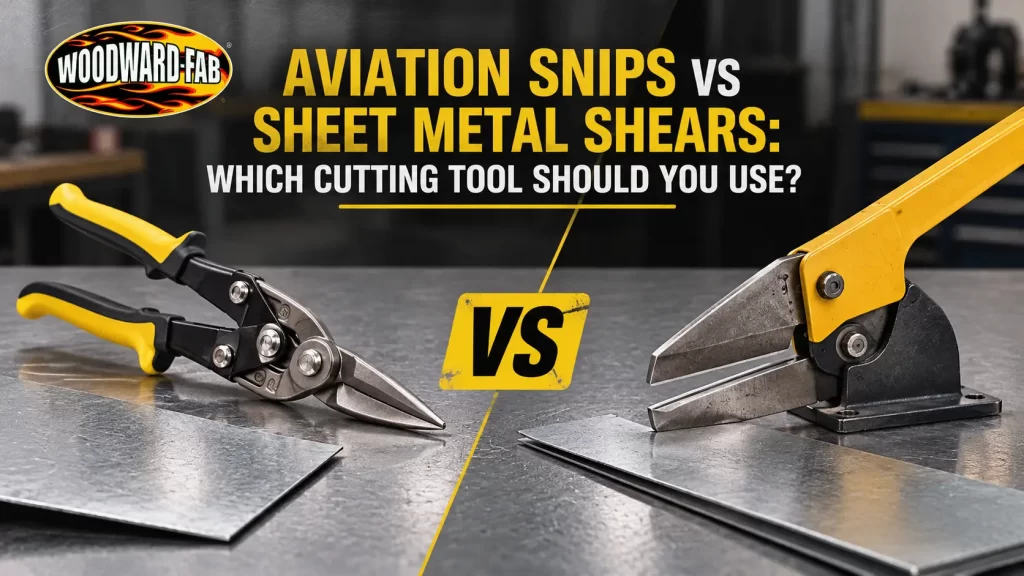
When you’re cutting sheet metal, the tool you choose can make a noticeable difference in the quality of the finished part. A small fabrication job may only require a pair of aviation snips, while larger sheets or repeated straight cuts may call for a dedicated sheet metal shear.
So, which is better: aviation snips or sheet metal shears?
The answer depends on what you’re cutting, the shape of the cut, material thickness, project volume, and the level of accuracy you need. Aviation snips are excellent for quick, detailed cuts and working around corners or curves. Sheet metal shears, particularly throatless and machine-style shears, are better suited for controlled, consistent cutting when you’re working with larger pieces or more demanding fabrication applications.
Let’s compare the two so you can choose the right sheet metal cutting tool for your workshop.
What Are Aviation Snips?
Aviation snips are handheld cutting tools designed specifically for cutting thin sheet metal. They look somewhat like heavy-duty scissors, but their jaws and leverage are designed to handle metal rather than paper or fabric.
They are commonly available in different configurations, including straight-cut, left-cut, and right-cut versions.
Aviation snips are particularly useful when you need to:
- Make short cuts
- Trim sheet metal
- Cut around corners
- Create curved or irregular cuts
- Make small adjustments to an existing panel
- Work in areas where a larger shear cannot reach
Their biggest advantage is control. Because you’re holding the tool directly in your hand, you can follow a marked line and make relatively small adjustments as you work.
For HVAC work, automotive restoration, ductwork, light fabrication, repairs, and DIY projects, aviation snips can be an extremely useful addition to a basic sheet metal tool kit.
However, they aren’t the ideal choice for every cutting job.
What Are Sheet Metal Shears?
Sheet metal shears use a shearing action to cut metal cleanly along a defined path. Depending on the design, they can be manually operated, foot-operated, powered, or designed as specialized throatless shears.
Unlike aviation snips, sheet metal shears are generally better suited to situations where repeatability, cleaner cuts, and higher productivity are important.
Woodward Fab offers a range of sheet metal shearing tools designed for different fabrication requirements.
For example, a throatless hand shear allows the material to move around the cutting area, making it easier to produce curves and irregular shapes without being restricted by a traditional shear throat.
This makes specialized shears useful for automotive restoration, custom fabrication, metalworking, and other applications where the shape of the cut matters.
Aviation Snips vs Sheet Metal Shears: What’s the Difference?
The simplest way to understand the difference is this:
Aviation snips are best for small, detailed, and accessible cuts, while sheet metal shears are better for controlled, repeatable, and higher-volume cutting.
| Feature | Aviation Snips | Sheet Metal Shears |
|---|---|---|
| Operation | Hand-operated | Manual, foot-operated, or powered |
| Best for | Small cuts and trimming | Larger or repeated cuts |
| Portability | Excellent | Depends on model |
| Curved cuts | Good | Depends on shear type |
| Straight cuts | Good for short cuts | Excellent |
| Production work | Limited | Better suited |
| Operator effort | Higher for repetitive work | Lower on suitable machines |
| Control | Excellent for detailed work | Excellent for consistent cuts |
| Workspace | Very small | Requires more space |
| Ideal users | DIYers, repair technicians, fabricators | Fabricators, workshops, production environments |
When Should You Use Aviation Snips?
Choose aviation snips when your project involves thin sheet metal and relatively short or detailed cuts.
For example, imagine you’re repairing an automotive panel and need to remove a small damaged section. You have already marked the area and need to follow a curved line around an edge.
A pair of aviation snips gives you the direct control needed to make that cut without setting up a larger machine.
They’re also useful for jobs such as:
- HVAC duct modifications
- Small automotive repairs
- Cutting flashing
- Trimming sheet metal edges
- Light-gauge fabrication
- Cutting small templates
- Making quick adjustments on-site
The main limitation is fatigue. Cutting large quantities of sheet metal by hand can become tiring, and the quality of the cut may suffer if the operator becomes fatigued.
When Should You Use Sheet Metal Shears?
Sheet metal shears become the better option when you’re working with larger pieces, longer cuts, thicker material, or repetitive fabrication work.
A dedicated shear can help maintain a more consistent cutting path and reduce the physical effort required compared with repeatedly using handheld snips.
For example, if a fabrication shop needs to cut multiple sheet metal blanks to the same dimensions, using a suitable shear can be much more efficient than cutting each piece manually.
Woodward Fab’s sheet metal shearing equipment includes options designed for different shop requirements.
For shops that need multiple operations from one machine, a 3-in-1 sheet metal shearing machine can combine shearing, bending, and rolling capabilities.
What About Throatless Hand Shears?
Throatless hand shears are an interesting middle ground between handheld cutting tools and conventional shearing equipment.
The throatless design allows the workpiece to move more freely around the cutting area. This can be particularly helpful when making curved or irregular cuts.
Woodward Fab’s throatless hand shears are designed for applications where control and flexibility are important.
They can be especially useful for custom automotive panels, restoration projects, and fabrication work where you’re not simply cutting a long straight line.
Which Tool Is Better for Curved Cuts?
If you’re asking specifically about curved sheet metal cuts, aviation snips can be a convenient option for small curves and tight areas.
However, for larger or more complex curved shapes, a throatless shear can offer greater flexibility.
The right choice depends on the material thickness, curve radius, size of the panel, and how many identical parts you need to produce.
For custom fabrication, having both tools available can actually be more practical than choosing one over the other.
Which Tool Is Better for Straight Cuts?
For short straight cuts, aviation snips are usually sufficient.
For long, straight, repetitive cuts, a sheet metal shear is generally the better choice.
A dedicated shear can help produce cleaner and more consistent cuts while reducing the amount of physical effort required from the operator.
This becomes particularly important in a fabrication shop where the same cutting operation may be repeated dozens or hundreds of times.
What About Material Thickness?
Material thickness is one of the most important factors to consider before choosing a cutting tool.
Never assume that a tool can safely cut a particular material simply because it looks similar to another sheet. Always check the manufacturer’s specifications for the specific tool and material you’re using.
Material type also matters. Mild steel, stainless steel, aluminum, and other metals can behave differently during cutting.
Woodward Fab’s sheet metal fabrication equipment is designed for a range of fabrication applications, and selecting the appropriate machine should always start with the material and thickness you’re working with.
For broader guidance on fabrication equipment, see Woodward Fab’s sheet metal fabrication equipment collection.
Aviation Snips or Shears: Which One Should You Buy?
The answer comes down to your actual workload.
Choose aviation snips if:
- You mostly make small cuts.
- You work on repairs or modifications.
- Portability is important.
- You need to cut around corners or small curves.
- You’re working on occasional fabrication projects.
Choose sheet metal shears if:
- You make long straight cuts.
- You’re cutting sheet metal regularly.
- You need consistent results.
- You’re working with larger panels.
- You’re running a fabrication shop.
- You want to reduce repetitive hand cutting.
Choose a throatless shear if:
- You frequently cut curves or irregular shapes.
- You work on automotive body panels.
- You need more flexibility than a conventional shear provides.
- You want controlled cuts without being restricted by a traditional throat.
The Best Approach for a Fabrication Shop
There doesn’t have to be a winner between aviation snips and sheet metal shears.
In many workshops, they perform completely different jobs.
Aviation snips can stay on the workbench for quick trimming, small adjustments, and detailed cuts. A dedicated shear can handle larger panels, straight cuts, and repetitive work.
This combination gives fabricators more flexibility without forcing one tool to handle every application.
Woodward Fab’s sheet metal hand tools can help cover everyday manual fabrication tasks, while its broader range of metal fabrication products provides equipment for cutting, bending, forming, rolling, and shaping.
Frequently Asked Questions
Are aviation snips the same as sheet metal shears?
No. Aviation snips are handheld cutting tools designed primarily for thin sheet metal and smaller cuts. Sheet metal shears use a shearing mechanism and are available in several designs for straight, curved, and higher-volume cutting applications.
Are aviation snips good for cutting thick sheet metal?
Aviation snips are intended for materials within their specified cutting capacity. For thicker material, a dedicated shear or other appropriately rated cutting machine may be more suitable. Always follow the manufacturer’s specifications.
What is the best tool for cutting sheet metal?
There isn’t one universal best tool. Aviation snips work well for small and detailed cuts, while sheet metal shears are better for longer, consistent, and repetitive cuts. A throatless shear can be useful for curves and irregular shapes.
Can sheet metal shears cut curves?
Some sheet metal shears are specifically designed to handle curved or irregular cuts. Throatless shears are particularly useful because their design allows the workpiece to move more freely during cutting.
Should a beginner use aviation snips or sheet metal shears?
For basic sheet metal work, aviation snips are often a practical starting point because they’re portable, straightforward, and versatile. As project size and cutting volume increase, adding a dedicated sheet metal shear can improve efficiency and consistency.
Final Thoughts
Choosing between aviation snips and sheet metal shears isn’t really about finding one tool that is better than the other. It’s about matching the cutting tool to the job.
For quick repairs, trimming, small panels, and detailed cuts, aviation snips offer excellent control and convenience. For longer cuts, larger panels, repetitive fabrication, and greater productivity, sheet metal shears are usually the more practical choice.
And when curved or irregular cuts are part of your regular work, a throatless hand shear can provide the flexibility you need.
The best fabrication setup is often the one that gives you the right tool for each stage of the job.
Explore Woodward Fab’s sheet metal shearing tools and sheet metal hand tools to find cutting solutions suited to your fabrication requirements.

Related Post:
- Metalworking Tool Selection Guide: Match the Tool to the Fabrication Task
- How to Read a Sheet Metal Gauge Chart: Gauge, Thickness & Material Explained
- Sheet Metal Forming Methods: Deep Drawing, Flanging, Hemming & More
- How to Choose the Right Sheet Metal Gauge for Automotive Projects
- Why Does Sheet Metal Crack When Bending? Causes and Solutions