
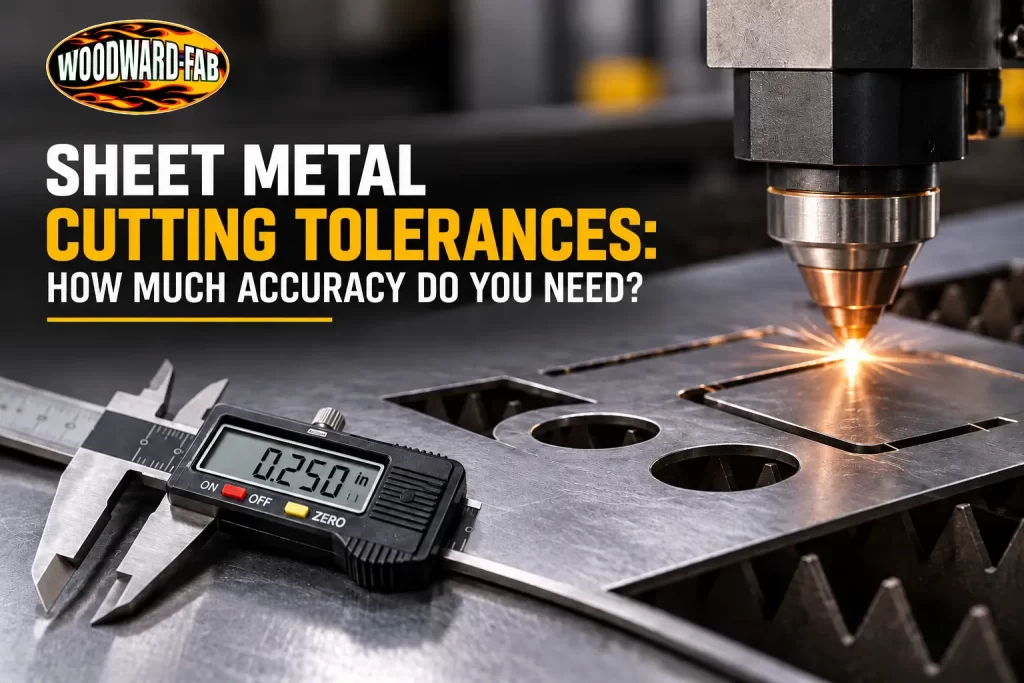
Sheet metal cutting tolerance is the acceptable variation between the specified dimension and the actual dimension of a cut part. The right tolerance depends on the material, thickness, cutting method, part geometry, equipment, and how the finished component will be used. Not every fabrication job requires extremely tight tolerances; the goal is to achieve the accuracy needed for the next operation without adding unnecessary cost or rework.
Key Takeaways
- Sheet metal cutting tolerance defines the acceptable dimensional variation of a cut part.
- There is no single tolerance that applies to every sheet metal cutting process.
- Material thickness, material type, cutting method, tooling, and part geometry all affect accuracy.
- Tight tolerances matter most when parts must fit, align, or assemble with other components.
- Consistent setup and repeatability can be just as important as achieving a very tight individual measurement.
- Choosing the right cutting equipment can help improve accuracy while reducing material waste and rework.
What Is Sheet Metal Cutting Tolerance?
Sheet metal cutting tolerance is the amount of dimensional variation allowed between the intended size of a part and the size actually produced after cutting.
For example, if a drawing specifies a 100 mm-wide component with a ±0.5 mm tolerance, an acceptable finished dimension would fall between 99.5 mm and 100.5 mm.
The important point is that tolerance is not the same as accuracy.
Accuracy describes how close the finished dimension is to the intended dimension. Tolerance establishes the range of variation that is acceptable for the application.
In practical fabrication, the required tolerance should be determined by what the part needs to accomplish. A decorative panel may not require the same dimensional control as a component that must align with several mounting holes.
Why Does Cutting Accuracy Matter in Sheet Metal Fabrication?
Cutting is often the first major operation performed on a sheet metal blank. The dimensions established during cutting can affect everything that follows.
A typical fabrication sequence may look like:
Cutting → Bending → Forming → Welding → Finishing → Assembly
If the original blank is incorrectly sized, subsequent operations may also be affected.
For example, a blank that is slightly oversized may require additional trimming. A blank that is undersized may not provide enough material to create the required flange or bend.
This is why cutting accuracy should be considered as part of the entire fabrication process rather than as an isolated measurement.
Woodward Fab’s existing guide to the sheet metal fabrication process explains how cutting connects with later bending, forming, joining, and finishing operations.
What Determines Sheet Metal Cutting Tolerance?
Several variables influence the dimensional accuracy and repeatability of a cut.
1. Cutting Method
The cutting method is one of the first factors to consider.
Common methods include:
- Hand shearing
- Power shearing
- Nibbling
- Saw cutting
- Plasma cutting
- Laser cutting
- Waterjet cutting
- Punching
Each process has different capabilities, limitations, and ideal applications.
For example, mechanical shearing can be highly effective for straight cuts, while other processes may be better suited to complex profiles or applications requiring different levels of dimensional control.
Woodward Fab’s sheet metal shearing tools include options for different fabrication requirements, from hand-operated shears to larger shearing equipment.
2. Material Thickness
Sheet thickness affects how the material behaves during cutting.
Thin sheet can move or deform more easily if it is not properly supported. Thicker material may require equipment with sufficient cutting capacity and rigidity.
The cutting machine should therefore be selected according to the material thickness and the required application.
3. Material Type
Steel, aluminum, stainless steel, and other metals can respond differently to the same cutting process.
Material hardness, ductility, surface condition, and thickness can all influence the cutting operation.
For this reason, a cutting setup that works well for one material should not automatically be assumed to produce identical results with another.
4. Part Geometry
Simple rectangular blanks are generally easier to produce consistently than complex profiles.
Accuracy can become more challenging when a part includes:
- Tight curves
- Small slots
- Narrow features
- Internal cutouts
- Multiple closely spaced features
- Complex contours
The more complex the geometry, the more important proper tooling, measurement, material support, and process control become.
Sheet Metal Cutting Tolerance Reference
There is no universal sheet metal cutting tolerance that applies to every machine or application.
Instead, consider the cutting process in relation to the type of work being performed:
| Cutting Method | Typical Application | Relative Accuracy Consideration | Best Suited For |
|---|---|---|---|
| Hand Shears | Light-gauge manual work | Depends strongly on operator technique and layout | Repairs, trimming, custom work |
| Throatless Shears | Straight and curved cuts | Good control for suitable sheet thicknesses | Custom fabrication and curved profiles |
| Power Shears | Repetitive sheet cutting | More consistent than purely manual cutting when properly set up | Production and repeated cuts |
| Nibblers | Intricate cuts and openings | Useful for complex shapes with limited surrounding distortion | Detailed profiles and internal cuts |
| Saw Cutting | Sheet, plate, and metal stock | Depends on blade, machine setup, and material | Straight cuts and stock preparation |
| Laser Cutting | Precision profiles | Capable of high dimensional control when properly specified | Detailed production parts |
| Plasma Cutting | Conductive metals and profiles | Accuracy depends on machine, settings, material, and thickness | General and industrial cutting |
Important: These are general process considerations, not guaranteed dimensional specifications. The actual achievable tolerance should come from the machine manufacturer, tooling setup, material specification, engineering drawing, or production requirement.
How Accurate Does Sheet Metal Cutting Need to Be?
The answer depends on what happens after the cut.
A useful question for a fabricator is:
How much dimensional variation can the finished part tolerate without affecting fit, function, appearance, or the next fabrication operation?
General Fabrication
For basic brackets, covers, panels, prototypes, or non-critical components, a relatively broad tolerance may be sufficient.
Assembly Components
If two or more components need to fit together, dimensional accuracy becomes more important.
Automotive Restoration
Custom body panels often require careful measurement because the cut blank must provide enough material for forming, trimming, welding, and final fitting.
Small-Batch Production
Repeatability becomes particularly important when producing multiple copies of the same component. The objective is not simply to make one accurate part; it is to make the parts consistently.
How Can You Improve Sheet Metal Cutting Accuracy?
Start With an Accurate Layout
Clearly establish the reference edge and cutting line before beginning the operation.
For repeated parts, use the same reference point and measurement method rather than changing the reference on every piece.
Support the Material Properly
Material movement can introduce dimensional variation. Make sure the sheet is positioned and supported appropriately for the selected cutting method.
Check the First Part
When producing multiple components, inspect the first cut before continuing with the entire batch.
This simple step can identify incorrect measurements, setup problems, or tooling issues before they result in significant scrap.
Maintain Cutting Equipment
Cutting performance can change as tooling wears or machine components become misaligned.
Regular inspection and maintenance can help maintain consistent results.
Measure Consistently
Use the same measurement method and reference points throughout a project. Consistency makes it easier to identify whether variation is coming from the material, machine, setup, or measurement process.
Woodward Fab’s existing content on machines and techniques used in sheet metal fabrication also highlights the importance of selecting fabrication equipment according to the operation and desired result.
Cutting Tolerance vs. Repeatability: What’s the Difference?
These terms are related but not identical.
Tolerance defines how much variation is acceptable.
Repeatability describes how consistently the same process produces the same result.
Imagine a shop producing ten identical brackets. If every bracket is produced within a narrow and acceptable dimensional range, the process has good repeatability.
For production work, this can be extremely valuable.
A fabrication process that produces one exceptionally accurate part followed by several inconsistent parts may be less useful than a process that reliably produces every part within the required specification.
What Happens When Cutting Tolerance Is Too Tight?
Tighter is not always better.
Requiring a tolerance that the application does not actually need can increase:
- Production time
- Inspection requirements
- Tooling demands
- Material waste
- Labor costs
- Rework
The right approach is to establish a tolerance based on function and downstream requirements.
If a component only needs to fit within a relatively broad range, there may be little practical benefit in demanding extremely tight dimensional control.
Common Sheet Metal Cutting Accuracy Problems
Parts Are Consistently Oversized or Undersized
Check the measurement reference, machine setup, cutting position, and tooling.
Parts Vary From One Piece to Another
Look for inconsistent material positioning, operator technique, machine movement, or worn tooling.
The Cut Edge Requires Excessive Finishing
The cutting method, tooling condition, machine settings, or material may need to be reviewed.
The First Part Fits but Later Parts Do Not
Check whether each piece is being positioned against the same reference point and whether the production setup is maintaining consistent alignment.
Expert Fabrication Tip
Don’t automatically chase the tightest possible tolerance.
Start with the functional requirement of the part. Determine how accurately the blank needs to be cut for the next operation, then select the cutting method and setup that can reliably achieve that requirement.
For small-batch fabrication, a repeatable setup is often more valuable than trying to achieve an unnecessarily tight dimension on every individual component.
This approach can help reduce scrap and rework while keeping fabrication practical and efficient.
How Cutting Accuracy Affects Bending and Forming
Cutting and bending should be planned together.
A blank may look correct immediately after cutting but still create problems when it reaches the brake or forming operation.
For example:
- An incorrect blank length can affect flange dimensions.
- An incorrect width can change the final position of a bend.
- An inaccurate cutout can interfere with assembly.
- Excess material may require additional trimming.
- Insufficient material may make the finished component unusable.
For projects where bending follows cutting, review the complete fabrication sequence before establishing the cutting dimensions.
Woodward Fab also provides resources covering sheet metal bending and fabrication techniques, which can help connect cutting decisions with subsequent forming operations.
Frequently Asked Questions
What is sheet metal cutting tolerance?
Sheet metal cutting tolerance is the acceptable difference between the specified dimension of a part and its actual cut dimension.
What is a typical tolerance for sheet metal cutting?
There is no single typical tolerance that applies to all sheet metal cutting. The appropriate tolerance depends on the cutting process, material, thickness, geometry, equipment, and application.
Does sheet thickness affect cutting accuracy?
Yes. Thickness can affect material behavior, cutting force, deformation, tooling requirements, and machine capability.
Which sheet metal cutting method is most accurate?
There is no universally best method. Laser and other precision cutting processes can provide high dimensional control for suitable applications, while properly set-up mechanical shears can provide excellent results for appropriate straight-cut applications.
How can I improve the accuracy of repeated sheet metal cuts?
Use a consistent reference point, properly support the material, verify the machine setup, inspect the first part, maintain the equipment, and use a consistent measurement process.
Why are my sheet metal parts different sizes after cutting?
Possible causes include inconsistent positioning, inaccurate layout, machine setup issues, tooling wear, material movement, or differences in operator technique.
Is cutting tolerance the same as bend tolerance?
No. Cutting tolerance concerns the dimensions produced during cutting. Bend tolerance relates to variation in the resulting bend location, angle, radius, or finished dimensions. Both can influence the final part.
Final Takeaway
The right sheet metal cutting tolerance is the one that reliably meets the requirements of the finished part.
Material, thickness, cutting method, tooling, geometry, machine condition, measurement technique, and operator setup all influence the final result.
Instead of automatically specifying the tightest possible tolerance, fabricators should consider the complete workflow—from the initial cut through bending, forming, welding, finishing, and assembly.
When the cutting method and equipment are matched to the application, and the setup is controlled consistently, fabricators can improve repeatability, reduce rework, and make better use of their material.
For fabrication projects that require accurate and repeatable sheet cutting, explore Woodward Fab’s sheet metal shearing tools and equipment and select equipment according to your material, thickness, geometry, and production requirements.

Related Post:
- Metalworking Tool Selection Guide: Match the Tool to the Fabrication Task
- How to Read a Sheet Metal Gauge Chart: Gauge, Thickness & Material Explained
- Sheet Metal Forming Methods: Deep Drawing, Flanging, Hemming & More
- How to Choose the Right Sheet Metal Gauge for Automotive Projects
- Aviation Snips vs Sheet Metal Shears: Which Cutting Tool Should You Use?