
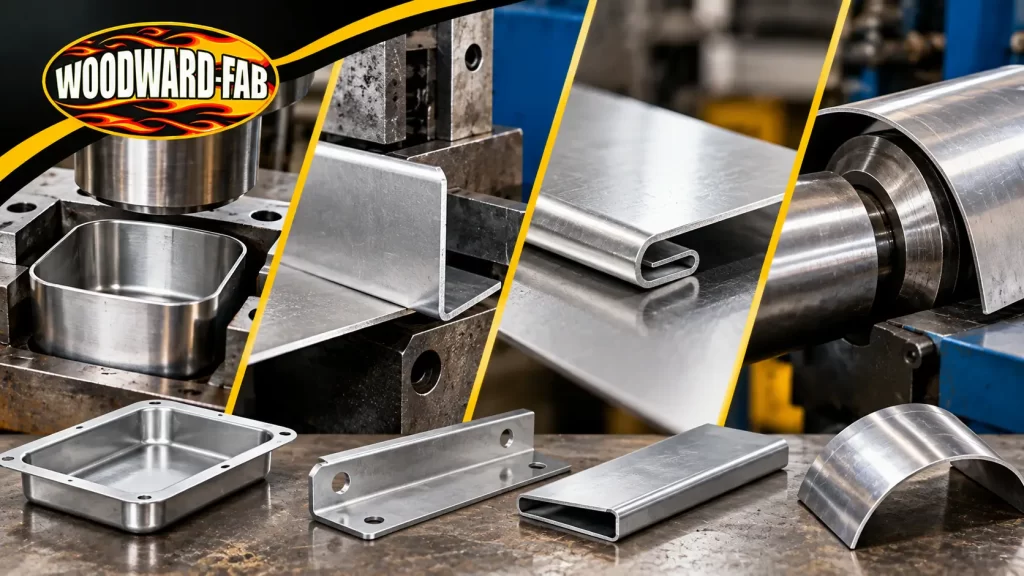
Sheet metal forming is a manufacturing process used to shape flat metal sheets into useful components without removing a significant amount of material. From automotive body panels and brackets to enclosures, ducts, and industrial components, different forming techniques allow manufacturers to create a wide range of shapes and profiles.
Understanding sheet metal forming methods is important when selecting the right process for a project. The material type, thickness, desired shape, production volume, and required finish can all influence which technique is suitable.
Some common methods include bending, deep drawing, flanging, hemming, stretching, and stamping. Each process works differently and is suited to specific applications.
In this guide, we’ll explain the most common sheet metal forming processes, how they work, and where they are commonly used.
What Is Sheet Metal Forming?
Sheet metal forming is the process of changing the shape of a metal sheet using mechanical force, while generally maintaining the material’s overall volume.
Unlike machining, where material is removed to create a specific shape, forming primarily reshapes the existing sheet. Depending on the application, forming can be performed using presses, dies, brakes, rollers, punches, or other specialized equipment.
The objective is to achieve the required shape while avoiding problems such as cracking, excessive thinning, wrinkles, or unwanted deformation.
The appropriate forming method depends on factors such as:
- Type of metal
- Sheet thickness
- Required shape
- Bend radius
- Material ductility
- Production volume
- Required dimensional accuracy
Common Sheet Metal Forming Methods
There are several sheet metal forming techniques, and each has a different purpose. Here are some of the most commonly used methods.
1. Sheet Metal Bending
Bending is one of the most common sheet metal forming methods. It involves applying force to a sheet to create an angle or curved profile without cutting the material.
A press brake is commonly used for controlled bending operations. Depending on the tooling and setup, the sheet can be formed into simple angles, channels, boxes, and other shapes.
Woodward Fab offers a range of sheet metal bending tools and brakes designed for different fabrication applications.
Bending is widely used in brackets, cabinets, panels, frames, and other fabricated components.
Factors such as material thickness, bend radius, tooling, and material properties should be considered when determining how a sheet will behave during bending.
For more information about press brake applications, see Woodward Fab’s guide to press brakes for sheet metal bending .
2. Sheet Metal Deep Drawing
Sheet metal deep drawing is a forming process used to produce hollow or cup-shaped components from a flat sheet.
During the process, a sheet blank is positioned over a die and pushed into the die cavity using a punch. The material flows into the cavity and takes its shape.
Deep drawing is commonly used for components such as:
- Containers
- Cups
- Housings
- Automotive components
- Kitchen and appliance parts
- Cylindrical or box-shaped components
Deep drawing can produce relatively deep shapes compared with conventional bending. However, controlling material flow is important. Excessive force or unsuitable material conditions can cause tearing, wrinkling, or thinning.
Woodward Fab also offers sheet metal presses that can be used for a range of pressing and forming applications.
3. Sheet Metal Flanging
Sheet metal flanging involves forming a flange or raised edge along part of a sheet or around an opening.
A flange can provide additional strength, create an attachment surface, or help connect one component to another.
Flanging is commonly used around:
- Openings
- Edges
- Panels
- Tubes
- Ductwork
- Automotive body components
Depending on the application, flanges can be produced using presses, dies, specialized forming tools, or other sheet metal equipment.
The size and shape of the flange should be considered carefully because excessive deformation can affect the finished component.
4. Sheet Metal Hemming
Sheet metal hemming is a forming process in which an edge of the sheet is folded over itself, typically to create a finished or reinforced edge.
Hemming can improve edge safety by reducing exposed sharp edges. It can also increase rigidity and provide a cleaner appearance.
This process is frequently used in automotive body panels, doors, covers, appliance components, and other products where a smooth finished edge is desirable.
Depending on the design, the edge may be folded partially or completely over the adjacent sheet.
5. Sheet Metal Stretching
Stretch forming involves stretching a sheet while forming it over a die or forming surface. The material is placed under tension while being shaped into the desired contour.
This method is useful for producing smooth, large-radius curves and components with complex profiles.
Stretch forming is commonly associated with applications where maintaining a controlled surface contour is important, including certain aerospace, automotive, and industrial components.
Because the material is placed under tension, the forming parameters need to be carefully controlled to prevent excessive thinning or failure.
For other sheet metal forming applications involving curved panels, fabricators can also use specialized forming equipment such as 3-in-1 sheet metal machines that combine multiple operations in one machine.
6. Sheet Metal Stamping
Stamping is a broad category of metal forming methods that uses presses, dies, punches, or combinations of these tools to shape sheet metal.
Depending on the tooling, stamping can include operations such as:
- Bending
- Punching
- Drawing
- Embossing
- Forming
Stamping is particularly useful for producing large quantities of consistent components. Once suitable tooling has been developed, production can be repeated efficiently.
The process is widely used in automotive, appliance, electronics, and industrial manufacturing.
Woodward Fab’s industrial presses include equipment for pressing, punching, forming, and related metalworking applications.
7. Roll Forming
Roll forming continuously bends a long strip of sheet metal through a series of rollers. Each set of rollers progressively changes the material’s shape until the desired profile is achieved.
Unlike some press-based forming processes, roll forming is particularly suited to producing long components with consistent cross-sectional profiles.
Common examples include channels, rails, panels, trim, and structural profiles.
The progressive nature of the process allows complex profiles to be created through a sequence of smaller forming operations.
Sheet Metal Forming vs. Sheet Metal Fabrication
Sheet metal forming is one part of the broader field of sheet metal fabrication.
Sheet metal fabrication can include multiple operations, such as:
- Cutting
- Bending
- Forming
- Punching
- Welding
- Joining
- Finishing
Forming specifically focuses on changing the shape of the sheet, while fabrication can involve several processes to create the final component.
For example, a fabricated metal enclosure may first be cut from a sheet, then bent and formed, followed by welding or fastening and surface finishing.
Understanding how these processes work together helps manufacturers plan an efficient fabrication workflow.
For a broader overview of manufacturing processes used with sheet metal, see Woodward Fab’s article on sheet metal manufacturing processes .
How to Choose the Right Forming Method
Choosing between different sheet metal forming processes depends on the component and production requirements.
Material Type
Steel, aluminum, stainless steel, and other metals have different properties. Strength, ductility, and thickness can affect how a material responds to forming.
Part Shape
Simple angles may only require bending, while deep or hollow components may require deep drawing. Complex curved profiles could require stretching or multiple forming operations.
Material Thickness
The thickness of the sheet influences the force required and the capabilities of the forming equipment.
Production Volume
For high-volume production, processes such as stamping or roll forming can be suitable because they can produce consistent parts repeatedly.
Dimensional Requirements
Projects with tight dimensional requirements may require carefully selected tooling and controlled forming processes.
Common Sheet Metal Forming Problems
Even when the correct process is selected, forming can produce defects if the material, tooling, or process parameters are not properly controlled.
Cracking: Excessive deformation can cause the material to crack, particularly around tight bends or highly formed areas.
Wrinkling: Uncontrolled material flow can result in wrinkles, especially during drawing operations.
Thinning: Some forming processes can cause localized reduction in material thickness.
Springback: After forming force is removed, the material may partially return toward its original shape.
Surface damage: Improper tooling, excessive friction, or unsuitable handling can mark the material.
Proper material selection, tooling, lubrication where appropriate, and process control can help reduce these problems.
Final Thoughts
Understanding different sheet metal forming methods makes it easier to determine how flat sheet material can be transformed into functional components. Bending is useful for creating angles and profiles, while sheet metal deep drawing is suited to hollow shapes. Sheet metal flanging can create reinforced or connecting edges, and sheet metal hemming can produce smooth, finished edges.
Other techniques, including stretching, stamping, and roll forming, provide additional options for producing specific shapes and profiles.
The right process ultimately depends on the material, thickness, geometry, production requirements, and available equipment. By understanding the capabilities and limitations of each forming technique, fabricators can select an appropriate approach and produce more consistent results.
Frequently Asked Questions
What are the most common sheet metal forming methods?
Common methods include bending, deep drawing, flanging, hemming, stretching, stamping, and roll forming. The appropriate method depends on the required shape, material, thickness, and production requirements.
What is sheet metal deep drawing used for?
Deep drawing is used to create hollow or cup-shaped components from flat sheet metal. Common applications include containers, housings, appliance components, and certain automotive parts.
What is the difference between flanging and hemming?
Flanging creates a raised or extended edge on sheet metal, often around an opening or along an edge. Hemming folds an edge back over itself to create a finished or reinforced edge.
Is sheet metal forming the same as sheet metal fabrication?
No. Sheet metal forming is a specific group of processes used to shape sheet metal. Sheet metal fabrication is a broader term that can include forming, cutting, bending, welding, joining, and finishing.

Related Post:
- Metalworking Tool Selection Guide: Match the Tool to the Fabrication Task
- How to Read a Sheet Metal Gauge Chart: Gauge, Thickness & Material Explained
- How to Choose the Right Sheet Metal Gauge for Automotive Projects
- Aviation Snips vs Sheet Metal Shears: Which Cutting Tool Should You Use?
- Why Does Sheet Metal Crack When Bending? Causes and Solutions