
A press rated for 20 tons may look like the obvious upgrade from a 12-ton machine. But what happens when the part cannot fit between the uprights, or the punch cannot reach the location where force needs to be applied?
For many metal fabrication jobs, the shape of the press frame matters just as much as its rated capacity.
Consider two common workshop tasks. One fabricator needs to punch a hole several inches inward from the edge of a metal panel. Another needs to remove a bearing from a mechanical assembly while supporting the component on press plates.
Both operations require controlled force, but they present different challenges in workpiece access, tooling, and support. Understanding the differences between C-frame and H-frame hydraulic presses can help you choose equipment that fits your work.
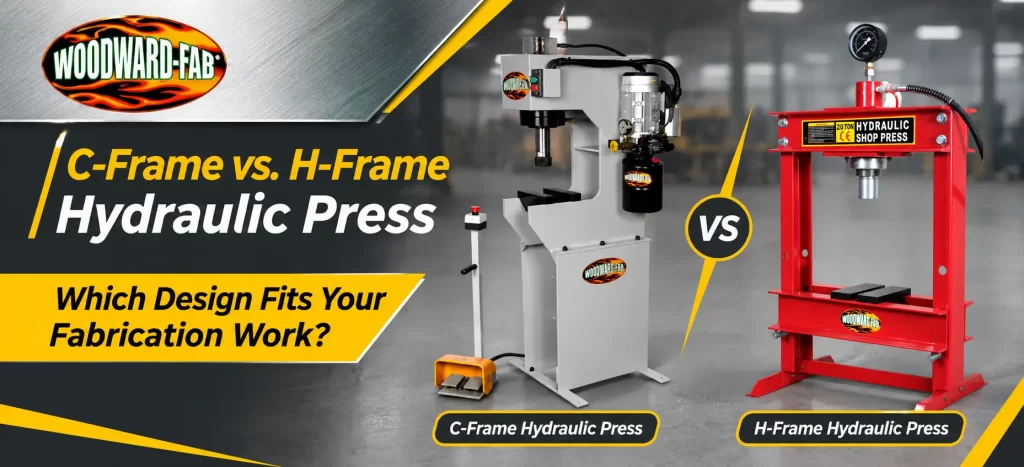
A C-frame press offers an open-front design with access from three sides, making it useful for certain punching, forming, and straightening tasks. An H-frame press uses two vertical uprights and is commonly used for bearing removal, assembly, pressing, and general workshop applications. The right choice depends on workpiece access, tooling clearance, load capacity, and support requirements.
The Main Difference: Open Access vs. Enclosed Support
A C-frame press has an open-front structure with access from three sides. Its ram and bed are connected by a frame that resembles the letter C.
An H-frame press uses two vertical uprights connected by crossmembers, creating a structure resembling the letter H. Its working area is generally positioned between the uprights.
A C-frame design can make it easier to position certain workpieces beneath the ram, while an H-frame design is commonly used for pressing tasks that benefit from a supported working area between two uprights.
Neither design is automatically better for every application. Actual capacity, rigidity, alignment, and performance depend on the specific machine and its construction.
Start With the Part, Not the Press
Before comparing hydraulic press models, examine the component you need to work on. Three measurements can reveal which configuration deserves closer consideration.
1. How Far Into the Workpiece Must the Tool Reach?
Imagine punching a hole in a large sheet-metal panel. If the hole is farther inward from the edge, the distance from the ram centerline to the back of the frame becomes important.
This measurement is called throat depth. A C-frame press with sufficient throat depth may allow the operator to position the panel beneath the tooling without the frame interfering with the material.
2. How Tall Is the Workpiece and Tooling Assembly?
The available vertical opening determines whether the workpiece, fixtures, and tooling can fit beneath the ram.
- The component being pressed
- Supporting plates or fixtures
- Pressing adapters
- Required ram travel
- Loading and removal clearance
Daylight opening, throat height, and stroke length should be evaluated separately.
3. How Will the Workpiece Be Supported?
Removing a bearing, straightening a shaft, or forming a bracket can require very different fixtures. Determine where force will be applied and how the component will be supported throughout the operation.
C-Frame vs. H-Frame Press: Practical Comparison
| Selection Factor | C-Frame Press | H-Frame Press |
|---|---|---|
| Frame geometry | Open-front, C-shaped | Two-upright, H-shaped |
| Workpiece access | Typically three-sided | Between uprights |
| Key clearance | Throat depth and vertical opening | Inside width and working height |
| Common applications | Punching, forming, pressing, straightening | Bearing work, pressing, assembly, straightening |
| Large panel handling | May offer easier access | Uprights can restrict positioning |
| Tooling considerations | Reach, alignment, throat clearance | Bed support, fixture width, clearance |
Actual performance depends on the machine’s construction, rated capacity, and manufacturer operating requirements.
Which Press Works Better for Your Application?
Workshop Scenario 01
Punching or Forming a Metal Panel
A fabrication shop needs to create a feature in a steel panel several inches inward from its edge. The first concern is whether the panel can be positioned beneath the ram.
A C-frame press may be advantageous because its open-sided design can accommodate certain panel shapes more easily.
- Check available throat depth
- Verify tooling dimensions
- Consider material thickness
- Calculate required punching or forming force
- Confirm permitted loading conditions
Explore Woodward Fab C-Frame Shop Presses .
Workshop Scenario 02
Removing a Bearing From a Mechanical Assembly
An automotive repair or maintenance shop needs to remove a press-fit bearing. The part must rest securely on suitable supports while the ram applies force at the correct location.
- Overall component width
- Space between frame uprights
- Available working height
- Ram stroke
- Bearing removal tooling
- Required pressing force
Explore Woodward Fab Hydraulic Shop Presses .
Workshop Scenario 03
Straightening a Bent Metal Component
Straightening a metal bar or shaft requires suitable support locations and controlled force application.
For long components, workpiece access and support spacing may become more important than nominal frame shape.
Why Press Tonnage Alone Can Be Misleading
Press capacity is commonly expressed in tons of force. A higher tonnage rating indicates greater nominal force capacity, but it does not automatically mean the machine is suitable for a particular fabrication task.
Consider a hypothetical choice between a 16-ton C-frame press and a 20-ton H-frame press.
The 20-ton machine offers higher nominal capacity. However, if the part cannot fit between its uprights or the tooling cannot reach the required location, that additional capacity may provide little benefit.
Five Specifications Worth Checking Together
- Rated capacity: Maximum permitted force under specified operating conditions.
- Throat depth: Distance from the ram centerline to the rear frame obstruction.
- Working opening: Available vertical space for the workpiece and tooling.
- Ram stroke: Distance the ram can travel.
- Bed dimensions: Space available to support workpieces and fixtures.
Woodward Fab Press Options for Different Workshop Requirements
Woodward Fab offers C-frame equipment and hydraulic shop presses for a range of metalworking applications.
WFP16 Manual C-Frame Press — 16 Ton
The Woodward Fab WFP16 Manual C-Frame Press is designed for pressing and straightening applications.
Additional published dimensions include a 9-inch bed width and 10.5-inch distance under the ram.
PR103 Hydraulic Shop Press — 12 Ton
The Woodward Fab PR103 Hydraulic Shop Press is intended for pressing, bending, shaping, and assembly applications.
Features include a heavy-duty frame, hydraulic system, pressure gauge, and adjustable press plates.
PR104 Hydraulic Shop Press — 20 Ton
The Woodward Fab PR104 Hydraulic Shop Press provides a higher nominal capacity for suitable pressing applications.
These models differ in frame geometry, working dimensions, and intended applications. Compare individual specifications rather than selecting solely by tonnage.
A Five-Minute Press Selection Exercise
Before requesting a quote or ordering equipment, prepare a simple job specification.
| Question | Information to Record |
|---|---|
| What operation is required? | Pressing, punching, straightening, forming, assembly |
| What is the largest workpiece? | Length, width, height, geometry |
| Where will force be applied? | Required ram contact location |
| What tooling is necessary? | Die, adapter, plates, fixtures |
| How much force is required? | Calculated or verified requirement |
| What clearance is needed? | Workpiece and tooling height |
| How often will it be used? | Occasional or repeated operations |
What About Frame Deflection and Pressing Accuracy?
Frame stiffness matters when operations require controlled alignment. Under load, every press frame experiences some degree of elastic deformation.
The amount depends on frame geometry, materials, construction, applied force, and tooling arrangement.
An open C-frame can be more sensitive to certain bending effects than a comparably engineered closed-frame structure. However, this does not mean every H-frame press is more accurate or rigid than every C-frame press.
For precision-sensitive work, review the manufacturer’s specifications for allowable loading, alignment, and deflection rather than relying on frame appearance.
Four Questions to Ask Before Buying
Will the Part Fit in Its Actual Working Position?
Include fixtures, tooling, loading access, and removal clearance when checking the working area.
Can the Press Deliver the Required Force?
Determine the force needed for the material, geometry, operation, and tooling before selecting tonnage.
Does the Frame Provide the Necessary Access?
Check throat depth and side access for C-frame presses. For H-frame presses, examine upright spacing and working height.
Is the Equipment Suitable for the Expected Workload?
Consider frequency of use, setup time, maintenance, and the variety of operations the machine must handle.
Frequently Asked Questions
Is a C-frame press better than an H-frame press?
Neither is universally better. C-frame presses can provide convenient three-sided access, while H-frame presses are commonly used for supported pressing and maintenance tasks. Choose based on workpiece dimensions, tooling, and load requirements.
What is throat depth on a C-frame press?
Throat depth is the horizontal distance from the ram centerline to the rear frame obstruction. It helps determine how far into a workpiece the press can apply force.
Can an H-frame hydraulic press be used for metal bending?
Yes, some H-frame shop presses can bend metal with suitable tooling. The equipment must be rated for the material, dimensions, and required force. A dedicated sheet metal brake may be more appropriate for repeated long bends.
Does a higher-tonnage press always provide better results?
No. Higher tonnage increases nominal force capacity, but workpiece fit, tooling compatibility, support, and manufacturer operating limits remain essential.
Can a C-frame press straighten metal parts?
Yes, certain C-frame presses are designed for pressing and straightening. The operation must remain within rated capacity and approved loading conditions.
Choose a Press That Fits the Work, Not Just the Budget
The decision between a C-frame and an H-frame hydraulic press ultimately comes down to application fit.
A C-frame design may solve an access problem that an H-frame configuration cannot easily accommodate. An H-frame shop press may provide a practical setup for bearing removal, assembly, and general pressing.
Neither frame shape eliminates the need to verify tonnage, tooling, clearance, support, and operating limits.
For fabrication shops, the most useful press is one that can accommodate the intended work safely and consistently, not simply the model with the highest force rating.
Find the Right Press for Your Fabrication Shop
Compare Woodward Fab C-frame presses and hydraulic shop presses for different workshop applications.

Related Post:
- How to Select Welding Turning Rolls for Different Pipe Diameters and Loads
- Metalworking Tool Selection Guide: Match the Tool to the Fabrication Task
- How to Read a Sheet Metal Gauge Chart: Gauge, Thickness & Material Explained
- Sheet Metal Forming Methods: Deep Drawing, Flanging, Hemming & More
- How to Choose the Right Sheet Metal Gauge for Automotive Projects