
A fabrication shop receives an order for 60 identical steel tube sections. Each piece needs to be cut to length before welding.
Across the shop, another fabricator is working on a custom metal bracket with a curved profile and several changes in direction.
Both jobs involve cutting metal. Both could involve a band saw. But the machine that makes one job easier may be poorly suited to the other.
The difference comes down to how the material moves through the blade, how the cut is controlled, and what happens after the first piece is finished.
For shops evaluating horizontal and vertical metal cutting band saws, these operational differences are often more useful than comparing motor horsepower alone.
Two Cutting Jobs, Two Different Approaches
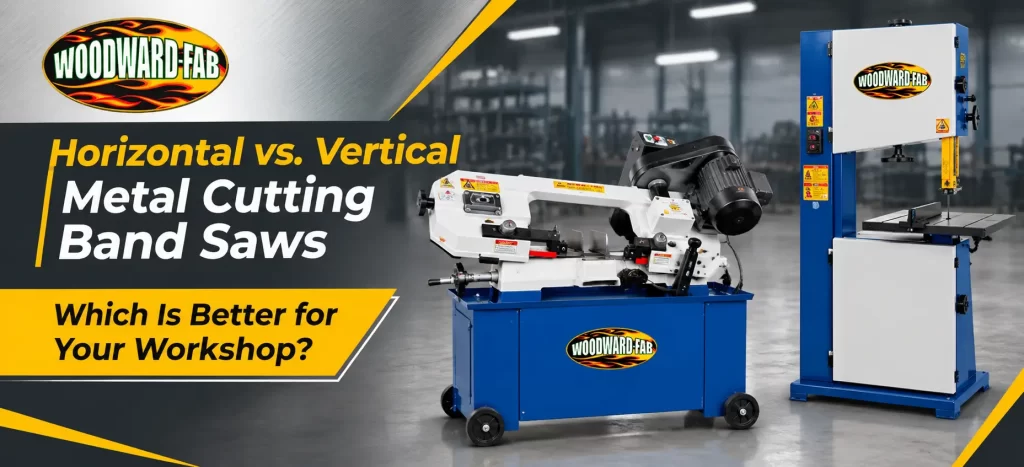
A horizontal band saw typically holds the material stationary while the saw head and blade move downward through the workpiece.
A vertical band saw keeps the blade moving vertically through a fixed cutting area. The operator generally guides the workpiece across a table.
Horizontal band saws are generally better suited to repeatable cut-to-length work, including tubing, bars, and structural stock. Vertical band saws are often better suited to cutting profiles, curves, and irregular shapes. The best choice depends on material, cut geometry, production volume, and required finish.
Follow the Material Through the Workshop
The Horizontal Band Saw Workflow
A fabricator receives a length of rectangular steel tubing that must be divided into shorter pieces.
The operator measures the required length, positions the material in the vise, secures it, and starts the cut. The saw head advances through the material while the workpiece remains clamped.
Common applications include:
- Round steel tubing
- Square and rectangular tubing
- Solid metal bars
- Angle iron
- Compatible structural stock
Securing the stock in a repeatable position can help simplify preparation of multiple components for welding or assembly.
The Vertical Band Saw Workflow
A fabricator needs to create a curved bracket from a metal blank. A straight cut can remove excess material, but the final profile requires changes in direction.
On a suitable vertical metal cutting band saw, the operator guides the workpiece along the intended cutting path.
Typical applications include:
- Curved profiles
- Irregular shapes
- Custom brackets
- Prototype components
- Certain trimming operations
Results depend on blade selection, material support, operator technique, and machine capabilities.
The Hidden Cost of Choosing the Wrong Saw
The purchase price of a metal cutting saw is easy to compare. Time lost between cuts is less obvious.
Imagine producing 40 identical tube sections. Repeated layout, repositioning, and checking can consume a significant part of the job.
For a one-off bracket with an irregular perimeter, a machine optimized for straight stock may require additional operations to produce the desired shape.
The right equipment should support the complete cutting workflow:
The best machine is often the one that simplifies the steps your shop performs most frequently.
What Changes When You Cut Different Materials?
Metal cutting performance depends on material properties, cross-sectional geometry, blade selection, cutting speed, and feed control.
Mild Steel
Mild steel is common in frames, brackets, and general fabrication. Horizontal band saws can provide a practical solution for straight cuts through round, square, and rectangular stock.
Stainless Steel
Stainless steel can be more demanding to cut because of its mechanical properties and tendency to work-harden under unsuitable conditions.
Use appropriate tooth selection, controlled feed, and suitable cutting fluid where recommended.
Aluminum
Aluminum is commonly used in lightweight structures and custom fabrication. Chip formation and blade loading can affect performance, so select cutting conditions for the specific alloy.
Hollow Tubing vs. Solid Bar
A blade cutting hollow tubing repeatedly enters and exits material as it passes through the tube walls. Solid bar stock presents a more continuous cutting section.
These differences influence tooth engagement and chip clearance.
When Miter Cutting Becomes Important
Many fabrication projects require angled cuts rather than square ends.
- Structural frames
- Support brackets
- Metal furniture
- Automotive fabrication
- Equipment stands
- Welded assemblies
A horizontal miter band saw allows the cutting angle to be adjusted within its supported range.
Depending on the design, the saw head may swivel while the stock remains positioned in the work area. This can be useful when handling long material.
However, cutting capacity often decreases at larger miter angles. Always check the manufacturer’s capacity chart for the required angle.
Woodward Fab WFS56 vs. WFS712: Choosing a Horizontal Miter Band Saw
Woodward Fab offers horizontal miter band saws for metal fabrication applications. The WFS56 and WFS712 demonstrate why cutting capacity, angle range, and shop requirements should be reviewed together.
WFS56 Manual Miter Band Saw
The Woodward Fab WFS56 Manual Miter Band Saw is designed for cutting metal stock at different angles.
Additional features include:
- Hydraulic fine-feed control
- Ball-bearing blade guides
- Quick-approach vise
- Adjustable work stop
WFS56 Cutting Capacities
| Angle | Round Stock | Rectangular Stock |
|---|---|---|
| 90° | 5 in. | 4 × 6 in. |
| 45° | 3¾ in. | 2¾ × 3¾ in. |
| 60° | 1¾ in. | 1¾ × 2⅛ in. |
WFS712 Hydraulic Metal Cutting Miter Band Saw
The Woodward Fab WFS712 Miter Band Saw provides a larger published cutting capacity.
Features include:
- Hydraulic fine-feed control
- Ball-bearing blade guides
- Through-guide coolant delivery
- Wheels for moving the machine within the shop
WFS712 Cutting Capacities
| Angle | Round Stock | Rectangular Stock |
|---|---|---|
| 90° | 7 in. | 7 × 12 in. |
| 45° | 5 in. | 4¾ × 4¾ in. |
The WFS56 offers a maximum published miter angle of 60 degrees, while the WFS712 provides greater cutting capacity for larger workpieces but a maximum miter angle of 45 degrees.
Choose based on material dimensions, required angles, and production needs rather than motor size alone.
Five Questions That Reveal Which Saw Your Shop Needs
1. Are Most Cuts Straight or Contoured?
For cutting tubing, bar stock, and structural sections to length, prioritize horizontal band saws. For frequent irregular profiles, investigate suitable vertical metal cutting band saws.
2. How Often Do You Repeat the Same Cut?
Repeated cut-to-length operations place greater importance on workholding, length stops, feed control, and ease of resetting material.
3. What Is the Largest Material You Regularly Cut?
Record your common workpiece dimensions and compare them with the manufacturer’s rated cutting capacity at each required angle.
4. How Much Space Is Available Around the Saw?
Consider loading, stock support, and removal clearance in addition to the machine footprint.
5. What Happens After Cutting?
If components are immediately welded, cut accuracy and joint preparation may be especially important. Consider the downstream workflow.
Why Blade Selection Can Matter More Than Motor Size
A powerful saw with an unsuitable blade may produce disappointing results.
Tooth Pitch
Tooth pitch describes the number of teeth per inch. Choose a pitch suited to the material thickness, cross-section, and blade manufacturer’s guidance.
Blade Speed
Blade speed is commonly expressed in feet per minute. Different materials require different cutting conditions. Use the recommended speed range for the blade and workpiece.
Feed Control
Feed determines how the blade advances into the workpiece. Excessive feed can overload the blade, while insufficient feed may cause rubbing and inefficient cutting.
Blade speed, feed, tooth pitch, and workholding should be evaluated together.
Is a Vertical Band Saw Always Better for Curves?
Vertical band saws are often associated with curved cuts, but suitability depends on the shape being produced.
Blade width affects the minimum radius that can be cut without excessive blade twisting or binding. Tighter curves generally require narrower blades suitable for the machine and material.
For intricate internal cutouts, drilling, punching, plasma cutting, or another method may be more practical.
The goal is not to make one machine perform every cutting operation. It is to choose a process that produces the required geometry efficiently.
What Should a Small Fabrication Shop Buy First?
For a shop primarily building welded frames, brackets, stands, and tubular assemblies, a horizontal miter band saw is often a logical starting point.
A vertical metal cutting band saw becomes more compelling when the workload includes substantial contour cutting, prototype work, or irregular profiles.
Some shops may benefit from both configurations, while others can meet their needs with one saw and complementary cutting tools.
Frequently Asked Questions
What is the main difference between a horizontal and vertical metal cutting band saw?
A horizontal band saw typically holds the material in a vise while the blade assembly moves through it. A vertical band saw generally allows the operator to guide the workpiece through a fixed vertical cutting area. Horizontal models are commonly used for cut-to-length work, while vertical models are often used for profiles and irregular shapes.
Which band saw is better for cutting steel tubing?
A horizontal metal cutting band saw is often practical for straight or mitered cuts through steel tubing. Verify cutting capacity, blade speed, tooth pitch, and workholding.
Can a horizontal band saw make angled cuts?
Yes. Horizontal miter band saws can make angled cuts within their specified adjustment range. Cutting capacity may decrease at larger angles.
Can a vertical band saw cut straight metal pieces?
Yes. A suitable vertical metal cutting band saw can make straight cuts, although it may not offer the same stock-clamping and repeat-cut workflow as a horizontal saw.
What blade should I use for cutting stainless steel?
Choose a blade rated for stainless steel and matched to the material thickness and cross-section. Follow manufacturer recommendations for tooth pitch, blade speed, feed, and cutting fluid.
Is a horizontal band saw suitable for a small fabrication shop?
Yes, particularly when the shop frequently cuts bar stock, tubing, and structural sections to length. Choose a model based on workpiece size, miter requirements, available space, and workload.
The Better Saw Is the One That Matches Your Cutting Work
Horizontal and vertical band saws use similar cutting principles but support different fabrication workflows.
Horizontal machines are often practical for repeated straight and angled cuts through stock. Vertical machines offer advantages for certain contours and irregular shapes.
Evaluate the material, required geometry, number of pieces, and operations that follow before making a purchasing decision.
Explore Woodward Fab Metal Cutting Band Saws
Compare cutting capacities, miter angles, and available equipment for your fabrication shop.
View Metal Cutting Band Saws
Related Post: