
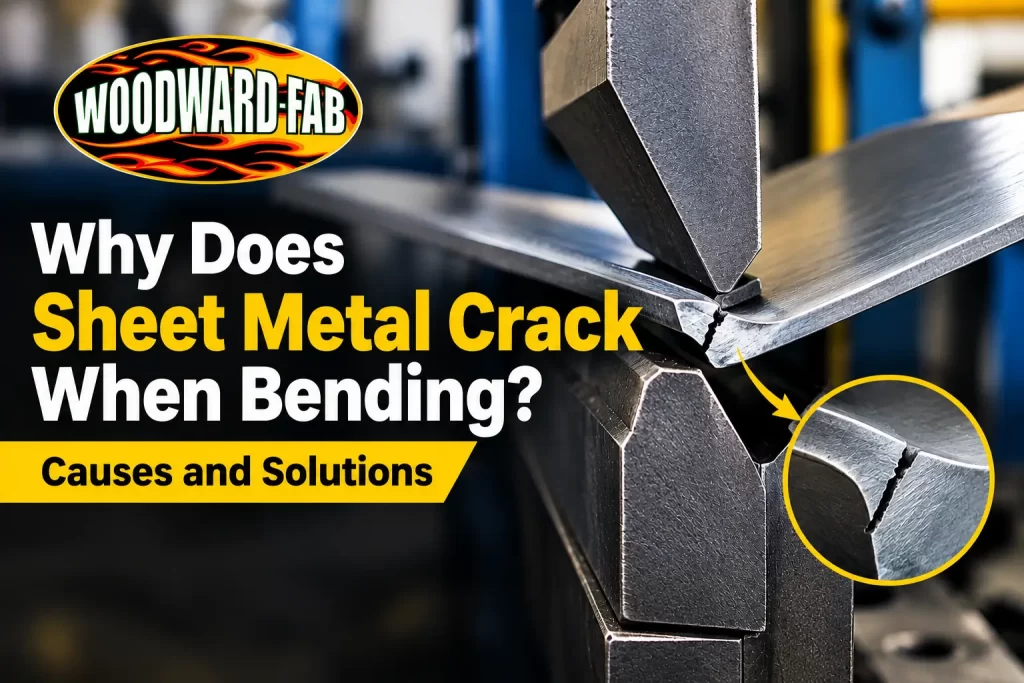
Sheet metal bending is a fundamental process in metal fabrication, used to create everything from automotive body panels and brackets to enclosures, ducts, structural components, and custom parts. However, one common problem can quickly turn a successful fabrication project into wasted material: sheet metal cracking during bending.
If you have ever made a bend only to discover cracks forming along the bend line, you may wonder: Why does sheet metal crack when bending?
The short answer is that cracking occurs when the metal is stretched beyond its ability to deform without breaking. Several factors can contribute to this problem, including an overly tight bend radius, material hardness, grain direction, work hardening, incorrect tooling, and defects near the bend.
Understanding these causes can help fabricators prevent cracks, improve part quality, and reduce material waste.
In this guide, we’ll explain why sheet metal cracks when bending, how to prevent bending cracks, and what to do when cracking occurs.
Why Does Sheet Metal Crack When Bending?
Sheet metal cracks during bending when the tensile strain on the outside of the bend exceeds the material’s ability to stretch without fracturing.
The most common causes are:
- Bend radius that is too tight
- Material with low ductility
- Incorrect grain direction
- Work-hardened material
- Incorrect punch or die selection
- Excessive forming force
- Damaged or poor-quality sheet metal
- Holes, slots, or notches too close to the bend
- Burrs or defects along cut edges
The solution usually involves selecting the appropriate material, bend radius, tooling, and forming technique for the application.
For professional sheet metal fabrication, understanding these variables is essential for producing accurate and durable parts.
What Happens to Sheet Metal When It Is Bent?
Before looking at the causes of cracking, it is important to understand what happens to sheet metal during bending.
When a flat sheet is bent, different areas of the material experience different types of stress.
The outside of the bend is placed under tension, meaning it stretches. The inside of the bend is compressed, while the area between them experiences comparatively little lengthwise deformation.
As the bend becomes tighter, the outside surface must stretch more.
If the material can accommodate the required deformation, it forms a clean bend. If the required strain exceeds the material’s ductility, microscopic fractures can develop and eventually become visible cracks.
This is why the correct sheet metal bend radius is so important.
7 Common Causes of Sheet Metal Cracking When Bending
1. The Bend Radius Is Too Tight
One of the most common reasons for sheet metal cracking is using a bend radius that is too small.
A tight radius forces the outside surface of the material to stretch significantly. If the metal cannot handle this amount of deformation, the outer surface may crack.
The minimum bend radius varies depending on the material and its condition. Aluminum, stainless steel, mild steel, and high-strength steels can have very different forming characteristics.
How to prevent it
If cracking occurs along the outside of a bend:
- Increase the inside bend radius.
- Check the recommended minimum radius for the material.
- Match your tooling to the required bend.
- Test the bend using scrap material.
- Avoid unnecessarily sharp bends.
Using appropriate sheet metal bending equipment can also provide better control over the forming process.
2. The Material Is Too Hard or Has Low Ductility
Material selection plays a major role in successful sheet metal bending.
Ductility refers to a material’s ability to deform plastically before breaking. Materials with lower ductility are generally more susceptible to cracking when subjected to tight bends.
Certain high-strength steels, hardened materials, and specific aluminum alloys may require larger bend radii or specialized forming techniques.
Material condition is equally important. Two sheets made from the same alloy can behave differently if they have different hardness or temper conditions.
Before bending, check:
- Material grade
- Alloy
- Thickness
- Hardness
- Temper
- Previous forming history
If a particular material repeatedly cracks under the same bending conditions, evaluate whether a more formable grade or condition would be more appropriate.
3. Incorrect Grain Direction
The rolling process used to manufacture sheet metal can create a directional grain structure.
Depending on the material, bending relative to this grain direction can influence how the sheet behaves during forming.
In some applications, bending parallel to the rolling direction can increase the likelihood of cracking compared with bending across the grain.
This is not a universal rule for every material, but grain orientation should be considered when forming parts where cracking is a concern.
How can you reduce the risk?
When possible:
- Identify the rolling direction.
- Determine how the bend line will be oriented.
- Follow material-specific forming recommendations.
- Test the material before production.
Considering grain direction during part layout is particularly important for precision sheet metal fabrication and applications involving tight bends.
4. The Material Has Been Work-Hardened
Work hardening occurs when metal becomes harder and less ductile after plastic deformation.
A sheet that has already been bent, stretched, rolled, flattened, or otherwise formed may have less ability to withstand additional deformation.
For example, repeatedly bending and straightening the same area can make the material increasingly difficult to form.
Eventually, another bending operation may cause cracking.
How to avoid work-hardening problems
Plan your forming sequence before fabrication.
Try to:
- Minimize repeated bending and straightening.
- Avoid unnecessary deformation.
- Use the correct forming sequence.
- Start with suitable material.
- Avoid concentrating too much deformation in one area.
Good process planning can be just as important as the machine used for the job.
5. Incorrect Bending Tooling
Even when the material and bend radius are correct, improper tooling can cause cracking.
The punch and die determine how the material is formed. If the tooling is not appropriate for the sheet thickness or material, the bend may experience excessive localized stress.
Worn or damaged tooling can also create inconsistent pressure and unwanted deformation.
Check these factors:
- Punch radius
- Die opening
- Tool alignment
- Tool condition
- Sheet thickness
- Material type
- Required bend angle
Choosing the right sheet metal forming tools can help create more consistent bends and reduce the risk of defects.
6. Holes and Cutouts Are Too Close to the Bend
Sometimes a crack appears near a bend even though the bend itself appears correct.
The problem may be the part design.
Holes, slots, notches, and sharp internal corners can create stress concentrations. When the sheet is bent, these areas may experience additional stress and become starting points for cracks.
How to prevent this problem
During part design, maintain adequate distance between:
- Holes and bend lines
- Slots and bend lines
- Cutouts and bends
- Notches and corners
If a feature must be located close to a bend, consider using an appropriate bend relief.
This small design change can prevent significant problems during fabrication.
7. Burrs, Scratches, or Material Defects
A crack does not always originate from the bending operation itself.
Scratches, burrs, edge damage, inclusions, or other material defects can act as stress concentration points.
When the sheet is bent, these defects can become the starting point for a crack.
Cutting processes can also influence the condition of the sheet edge. Depending on the application, edges produced through shearing, laser cutting, plasma cutting, or other methods may require inspection or preparation before forming.
Best practice
Before bending:
- Inspect the sheet surface.
- Check cut edges.
- Remove excessive burrs.
- Look for scratches or visible defects.
- Confirm material thickness.
- Check for inconsistencies between material batches.
If cracks appear only in certain sections of a sheet, investigate material quality rather than immediately changing the bending machine settings.
How to Prevent Sheet Metal Cracking During Bending
Preventing cracks starts before the sheet reaches the machine.
Use this checklist when preparing for a bending operation:
1. Select the Right Material
Choose a material and temper that provide sufficient ductility for the required bend.
2. Determine the Correct Bend Radius
Do not automatically choose the smallest possible radius. Use a radius appropriate for the material and thickness.
3. Consider Grain Direction
Where applicable, plan the bend orientation based on the material’s rolling direction.
4. Select the Correct Tooling
Use punches, dies, and other sheet metal forming tools appropriate for the material.
5. Inspect the Material
Look for surface defects, edge damage, scratches, and burrs.
6. Avoid Excessive Rework
Repeated bending and straightening can reduce the material’s remaining ductility.
7. Design Proper Bend Reliefs
Use bend reliefs where holes, slots, or cutouts could create excessive stress.
8. Perform a Test Bend
For important or unfamiliar applications, perform a test bend using the same material and tooling that will be used for production.
What Is the Best Bend Radius for Sheet Metal?
There is no single best bend radius for every type of sheet metal.
The appropriate radius depends on:
- Material type
- Material grade
- Thickness
- Hardness
- Temper
- Grain direction
- Bending method
- Tooling
- Required bend angle
A common mistake is choosing a bend radius based only on sheet thickness.
Instead, consider the complete combination of material properties and forming conditions.
If the sheet is cracking consistently along the outside of the bend, increasing the bend radius is one of the first adjustments worth testing.
Can You Bend Cracked Sheet Metal Again?
Once sheet metal has developed a significant crack, bending it again will usually not restore the original material strength.
Depending on the application, a damaged part may be:
- Replaced
- Cut and repaired
- Welded
- Reinforced
- Redesigned
- Re-formed using a larger radius
However, structural or safety-critical components should receive particular attention. A repaired crack may not provide the same performance as an undamaged component.
In many cases, identifying why the crack occurred and producing a new part using the corrected process is the better solution.
What About Curved Automotive Sheet Metal?
Not every sheet metal project involves a simple straight bend.
Automotive restoration and custom fabrication often require complex curves, compound shapes, wheel arches, fenders, and body panels.
This is where tools such as a shrinker/stretcher can be especially useful.
A shrinker/stretcher allows fabricators to manipulate the edge of sheet metal by either shrinking or stretching it. By gradually changing the edge length, fabricators can create curved shapes that would be difficult to achieve using conventional bending alone.
For a deeper look at this process, see our guide on How to Fabricate Curved Automotive Body Panels With a Shrinker Stretcher.
When using a shrinker/stretcher, gradual forming is important. Trying to create too much curvature in a single operation can introduce excessive deformation, distortion, or cracking.
Making several controlled passes generally provides better control over the final shape.
Explore Woodward Fab’s shrinker and stretcher equipment for applications involving curved sheet metal forming.
Sheet Metal Bending Cracking: Troubleshooting Guide
| Problem | Possible Cause | Solution |
| Crack along outside of bend | Bend radius too small | Increase bend radius |
| Crack follows material grain | Grain orientation | Change bend orientation where practical |
| Crack begins near a hole | Stress concentration | Move hole or add bend relief |
| Cracking after repeated forming | Work hardening | Reduce repeated deformation |
| Uneven cracking | Tool misalignment | Check tooling alignment |
| Cracking with one material grade | Low ductility | Consider a more formable material |
| Crack begins at cut edge | Burr or edge defect | Improve edge preparation |
| Cracking during curved forming | Excessive local deformation | Use gradual forming passes |
Frequently Asked Questions About Sheet Metal Cracking
Why does sheet metal crack instead of bending?
Sheet metal cracks when the tensile strain on the outside of the bend exceeds the material’s ability to deform without fracturing. A tight bend radius, low material ductility, work hardening, and unsuitable tooling can increase the risk.
How do I stop sheet metal from cracking when bending?
Start by checking the bend radius, material grade, hardness, grain direction, tooling, and edge condition. Increasing the bend radius and using suitable forming equipment are common ways to reduce cracking.
Does thicker sheet metal crack more easily?
Not necessarily. Thickness affects the force required to bend the material and the appropriate tooling, but cracking depends on several factors, including material properties, bend radius, grain direction, and forming technique.
Does grain direction matter when bending sheet metal?
Yes. Grain direction can influence the formability of certain rolled sheet metals. When cracking is a concern, evaluate the bend orientation relative to the rolling direction.
Why does aluminum crack when I bend it?
Certain aluminum alloys and tempers have lower ductility and may crack when bent too tightly. Selecting an appropriate alloy and temper and using a suitable bend radius can help prevent cracking.
Can a cracked sheet metal bend be repaired?
Some non-critical parts can potentially be repaired depending on the material and application. However, replacing the damaged component may be preferable for structural or safety-critical applications.
What causes cracks near holes in sheet metal?
Holes and cutouts can create stress concentrations, particularly when positioned too close to a bend. Increasing the distance from the bend or adding an appropriate bend relief can help.
What is the best way to bend automotive sheet metal without cracking?
Use the correct material, bend radius, and forming method. For complex curved automotive panels, gradual forming with appropriate sheet metal fabrication tools can help control deformation.
Why Proper Sheet Metal Fabrication Equipment Matters
The right equipment can make sheet metal forming more predictable and repeatable.
Whether you are working on automotive restoration, custom fabrication, repair work, or general metalworking, the combination of appropriate equipment, tooling, material, and technique determines the quality of the finished part.
Woodward Fab provides a range of sheet metal fabrication equipment designed for fabricators, automotive enthusiasts, restoration professionals, metalworking shops, and DIY users.
From bending and forming to shrinking, stretching, rolling, and pressing, selecting equipment according to the application can help reduce rework and improve fabrication results.
Final Takeaway
Sheet metal cracks when bending because the material is subjected to more tensile deformation than it can withstand.
The most important factors to investigate are:
- Bend radius
- Material ductility
- Material hardness
- Grain direction
- Work hardening
- Tooling
- Edge condition
- Part geometry
If a bend repeatedly cracks, increasing the bending force is not necessarily the answer. Instead, identify the underlying cause and adjust the material, bend radius, tooling, or forming process.
For complex automotive shapes, gradual forming with appropriate equipment can provide greater control and reduce the risk of excessive deformation.
With the right combination of material selection, bend radius, tooling, and fabrication technique, you can create cleaner bends, reduce material waste, and improve the consistency of your sheet metal projects.
Explore more sheet metal fabrication tools and equipment from Woodward Fab to find equipment for your next metalworking project.

Related Post:
- Metalworking Tool Selection Guide: Match the Tool to the Fabrication Task
- How to Read a Sheet Metal Gauge Chart: Gauge, Thickness & Material Explained
- Sheet Metal Forming Methods: Deep Drawing, Flanging, Hemming & More
- How to Choose the Right Sheet Metal Gauge for Automotive Projects
- Aviation Snips vs Sheet Metal Shears: Which Cutting Tool Should You Use?