
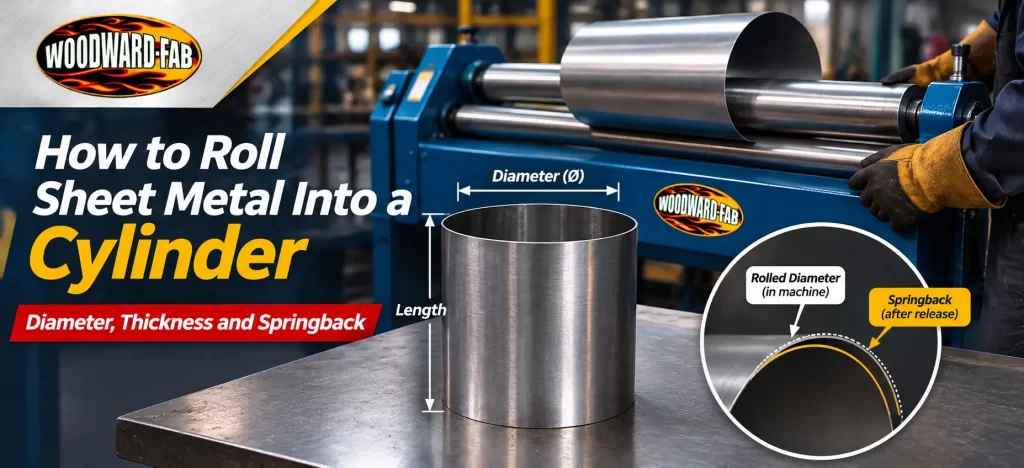
A fabrication shop receives an order for a cylindrical steel housing. The drawing specifies a 12-inch outside diameter, a 20-inch finished length, and a longitudinal welded seam. The material is 20-gauge mild steel.
At first glance, the job looks straightforward: cut a rectangular blank, pass it through a slip roll, and join the edges.
But three questions determine whether the finished cylinder will meet the drawing:
- How wide should the flat blank be before rolling?
- How much curvature is needed to compensate for springback?
- Can the selected slip roll handle the material thickness and diameter?
These decisions are connected. Incorrect blank length creates seam gaps or overlap. Insufficient rolling leaves the cylinder oversized. Poor edge control can produce flat spots that complicate assembly.
To roll sheet metal into a cylinder, calculate the developed blank length using the target diameter and material thickness. Verify the slip roll’s capacity, form the sheet progressively, compensate for springback, and check the seam before final joining.
Start With the Finished Cylinder, Not the Flat Sheet
The most important dimension is the one specified on the drawing.
Outside diameter (OD), inside diameter (ID), and centerline diameter are different measurements. Confusing them can create errors before material reaches the machine.
Consider this fabrication example:
| Job Requirement | Specification |
|---|---|
| Finished outside diameter | 12 inches |
| Cylinder axial length | 20 inches |
| Material | 20-gauge mild steel |
| Approximate thickness | 0.0359 inch |
| Joint | Longitudinal welded seam |
| Production | Small batch |
The 20-inch axial length must fit within the usable working width of the slip roll. Developed blank length determines how much material wraps around the circumference.
How to Calculate Flat Blank Length
For a thin sheet rolled into a complete cylinder, a useful starting estimate is:
L ≈ π × (OD − t)
OD = finished outside diameter
t = actual sheet thickness
π ≈ 3.1416
3.1416 × (12 − 0.0359) = approximately 37.59 inches
The initial rectangular blank would therefore measure approximately 37.59 inches in the rolling direction and 20 inches along the cylinder axis.
This assumes the neutral axis is near the material mid-thickness. The actual neutral-axis location, seam preparation, material behavior, and fabrication tolerances may affect the required length.
For a welded butt seam, account for the specified root gap and edge preparation. Lap seams or mechanically joined seams require different allowances.
What Happens to Sheet Metal During Rolling?
A slip roll creates curvature by passing sheet metal through an adjustable arrangement of rollers.
The outer surface experiences tensile strain while the inner surface experiences compressive strain.
Unlike a sharp bend made with a press brake, rolling distributes curvature along the sheet’s length.
1. Cylinder Diameter
Smaller cylinders require tighter curvature. The machine must be capable of forming the intended diameter, not merely accepting the sheet thickness.
Roller diameter does not equal the guaranteed minimum finished cylinder diameter.
2. Material Thickness
Thicker material generally requires greater forming force and may place higher loads on the machine.
Gauge numbers vary by material. A 20-gauge mild steel sheet does not necessarily match the thickness of 20-gauge aluminum or stainless steel.
Use a reliable sheet metal gauge chart and verify actual material thickness.
3. Material Properties
Mild steel, aluminum, and stainless steel respond differently to bending. Yield strength, work hardening, temper, and thickness influence the curvature retained after rolling.
The Rolling Sequence: From First Pass to Seam Fit-Up
For the example cylinder, the objective is uniform curvature without unnecessary surface marks or uneven edges.
-
Establish the first-pass curvature.
Begin with a prepared blank. Check that edges are square and remove burrs where required. Introduce the material evenly according to the machine instructions.
-
Build the radius progressively.
Additional passes increase curvature. Keep the sheet aligned with the rolls. Skewed feeding can produce a tapered cylinder, leaving one end larger.
-
Address leading and trailing edges.
Flat sections may remain near the ends because full bending action is not established immediately. Depending on equipment, pre-bending or additional forming may be needed.
-
Check the cylinder before joining.
Bring the edges together and inspect diameter, seam alignment, gap, flat spots, and unwanted taper.
For introductory machine operating guidance, see Woodward Fab’s guide to using slip rollers .
Springback: Why the Cylinder Opens After Rolling
Springback is the partial elastic recovery that occurs when forming pressure is removed.
A sheet may appear to have the required curvature while restrained by the machine, then open slightly after release.
For example, a cylinder intended to finish at 12 inches OD may measure larger after rolling because some of its imposed curvature has relaxed.
Form the material slightly beyond the target curvature, release it, measure the resulting diameter, and refine the setup. No single overbend percentage applies to every metal and thickness.
A Repeatable Springback Trial
- Record material grade, thickness, and rolling setup.
- Make a controlled forming pass.
- Release the material and measure its resulting curvature.
- Adjust the bending roll incrementally.
- Repeat until the required released diameter is achieved.
- Record the successful setup for subsequent parts.
Previously recorded settings should still be verified when material batches, thicknesses, or machine conditions change.
Which Woodward Fab Slip Roll Fits Your Fabrication Job?
A shop making short cylindrical sleeves has different equipment requirements from one producing wide industrial housings or repeated duct sections.
Woodward Fab offers manual, elite, and powered slip rolls with different working widths and published gauge capacities.
| Woodward Fab Model | Key Specifications | Fabrication Application |
|---|---|---|
|
WFSR1.0 12-Inch Slip Roll |
12-inch working width 20-gauge capacity 1-inch-diameter rolls |
Short sleeves and compact curved sheet metal components. |
|
WFSR24 24-Inch Slip Roll |
24-inch working width 20-gauge capacity 1.5-inch-diameter rolls |
Small cylindrical housings, curved panels, and prototypes. |
|
WFSR40 40-Inch Slip Roll |
40-inch working width 20-gauge capacity 2-inch-diameter rolls |
Wider sheet metal components and general fabrication. |
|
WFSR50 50-Inch Slip Roll |
50-inch working width 16-gauge capacity 3-inch-diameter rolls |
Larger cylindrical sections and thicker mild steel work. |
|
WFSRELITE41 41-Inch Elite Slip Roll |
41-inch working width 16-gauge capacity Two-speed gearbox Floor stand |
Shops requiring greater manual forming capability and setup flexibility. |
|
WFSR5116P 51-Inch Power Slip Roll |
51-inch working width 16-gauge capacity 2 HP motor 220V single-phase |
Repeated rolling of wider components with powered operation. |
Product specifications are based on Woodward Fab’s published listings. Verify material-specific capacities and minimum forming diameter before selecting equipment.
For the example 20-inch-long, 20-gauge mild steel cylinder, the Woodward Fab WFSR24 is a potential starting point because its published working width and gauge capacity accommodate those requirements.
Its ability to form the required 12-inch OD must still be confirmed against manufacturer guidance.
For other requirements, compare the Woodward Fab slip roll range or explore powered sheet metal rolling equipment .
When the Cylinder Does Not Match the Drawing
A dimensional problem does not always require a different machine. It may result from blank preparation, setup, or material variation.
| Problem | Likely Area to Investigate | Recommended Action |
|---|---|---|
| Seam edges do not meet | Blank length or insufficient curvature | Check developed length and springback before adjusting. |
| One end is larger | Roll alignment or skewed feeding | Check roller settings and sheet alignment. |
| Flat spots near seam | Unbent material ends | Review pre-bending capability or additional forming steps. |
| Consistently oversized cylinder | Springback | Increase curvature in controlled increments. |
| Surface marks | Dirty rolls or handling damage | Inspect roller cleanliness and material handling. |
For production work, identify the defect and verify the correction on a trial part before changing the entire batch.
Final Inspection: Diameter Is Only Part of the Job
A cylinder can have the correct average diameter and still be unsuitable for assembly.
Before releasing a component for welding or downstream processing, inspect the dimensions and features important to its application.
- Outside or inside diameter
- Axial length
- Roundness and taper
- Seam alignment and gap
- Surface condition
Measurement should follow the drawing’s specified datums and tolerances.
Welding can introduce additional distortion. Suitable fixturing, controlled welding sequences, and post-weld inspection may be necessary.
Frequently Asked Questions
How do you calculate the sheet metal length needed for a cylinder?
For thin sheet metal, an initial estimate is pi multiplied by the diameter at approximately the material mid-thickness. For a specified outside diameter, this is roughly pi times (OD minus thickness). Adjust for seam requirements and actual material behavior.
Can a slip roll make a complete cylinder?
Yes. Suitable slip rolls can form cylindrical shapes, but minimum forming diameter, unbent-end limitations, and part removal must be considered.
Does thicker sheet metal have more springback?
Not necessarily. Springback depends on yield strength, elastic modulus, thickness, forming radius, and other material and process conditions.
What is the difference between a slip roll and a ring roller?
A slip roll forms flat sheet metal into curved panels or cylindrical shells. A ring roller generally curves bar, rod, tube, or profile stock into rings and arcs.
How do you prevent a rolled cylinder from becoming tapered?
Feed the sheet squarely, maintain proper roller alignment, and use consistent adjustments across the working width. Measure both ends during trial forming.
From Flat Blank to Finished Cylinder
Accurate cylinder rolling begins with dimensional planning and ends with inspection, not simply with the sheet passing through a machine.
For repeatable results, calculate developed blank length, confirm equipment capabilities, form curvature progressively, and account for springback before seam joining.
Choosing equipment that matches the material, cylinder dimensions, and production workload can help fabrication shops reduce avoidable rework and improve forming consistency.
Explore Woodward Fab Sheet Metal Rolling Equipment
From compact manual slip rolls to wider powered machines, explore equipment for your sheet metal forming requirements.
View Sheet Metal Rolling Equipment
Related Post:
- How to Punch Clean Holes in Sheet Metal Without Distortion
- How to Select Welding Turning Rolls for Different Pipe Diameters and Loads
- Tool Mastery: How Expertise with Your Equipment Impacts Sheet Metal Results
- Cold Rolled Steel Sheets vs. Hot Rolled Steel Sheets: Which is Right for Your Project?
- Why Every Automotive Fabricator Needs an English Wheel: Benefits, Tips, and Safety Precautions