
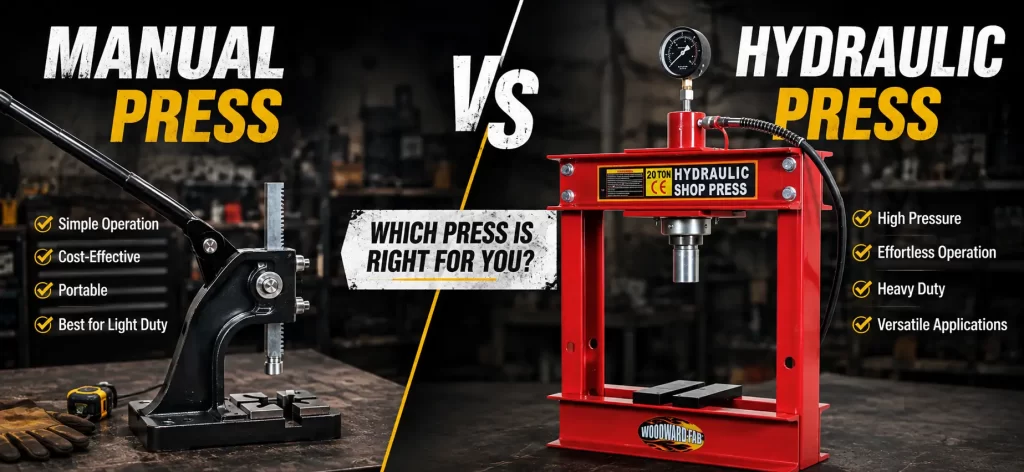
Choosing the right metal fabrication press can affect productivity, accuracy, operating costs, and the range of work a fabrication shop can handle. For many metalworkers, the decision comes down to a manual press or a hydraulic press. Understanding the difference between a manual vs hydraulic press can help you choose equipment that fits your workload instead of paying for capacity you may not need.
A manual metal press and a hydraulic metal press can both perform useful fabrication and maintenance tasks, but they are designed for different workloads. A manual press machine may be ideal for occasional pressing, straightening, and lower-volume work, while a hydraulic press for metal fabrication can provide greater force and convenient operation for demanding or repetitive applications.
Before investing in a metal fabrication press, consider the material you work with, required pressing force, production volume, available workspace, tooling, and the types of jobs you expect to perform.
What Is Manual Metal Press?
- A manual metal press uses operator-applied mechanical action to generate pressing force. This type of manual press machine can be a straightforward solution for shops that need pressing capability without an electrically powered hydraulic system.
- Woodward Fab’s WFP16 Manual C-Frame Press is a 16-ton manual press designed for pressing or straightening applications. A machine in this category can be useful for maintenance departments, automotive restoration work, small fabrication shops, repair operations, and other applications where pressing is performed periodically.
- A manual metal press can be a practical choice when simplicity, available shop space, and the frequency of pressing operations are more important than maximum production speed.
What Is a Hydraulic Metal Press?
- A hydraulic metal press uses hydraulic fluid, a pump, and a cylinder to generate controlled pressing force. Compared with a manually operated machine, a hydraulic press can reduce operator effort while providing substantial force for demanding applications.
- Hydraulic presses are commonly used for pressing bearings and bushings, straightening components, forming metal, bending, assembly, and other operations that require controlled force. Woodward Fab offers hydraulic shop press options in different capacities so fabricators can select equipment according to their applications.
- A hydraulic metal press can be a practical investment when a shop regularly performs high-force operations or needs a powered solution for a repetitive workflow.
Manual vs Hydraulic Press: Key Differences:
When comparing a manual vs hydraulic press machine, the biggest difference is how pressing force is generated and controlled. Manual equipment depends on operator input, while hydraulic equipment uses a pump and cylinder. This affects operator effort, workflow, production volume, and the applications each machine is best suited for.
| Factor | Manual Press | Hydraulic Press |
| Operation | Manual/operator powered | Hydraulic pump and cylinder |
| Typical workload | Occasional or lower volume | Frequent or heavier duty |
| Operator effort | Higher | Lower |
| Force capability | Depends on manual mechanism | Available in multiple capacities |
| Typical uses | Pressing, straightening, maintenance | Pressing, forming, bending, assembly |
| Best fit | Small or intermittent operations | Demanding and recurring applications |
When Should You Choose a Manual Press?
- A manual metal press may be the right choice when fabrication work is relatively light or intermittent, and you need a dependable machine for specific pressing tasks. If your shop performs occasional straightening, pressing, repair, or maintenance work, a manual press machine can provide the required capability without the complexity of powered hydraulic equipment.
- Manual presses can also be attractive for smaller workshops where budget, floor space, and power requirements are important considerations. However, compare rated capacity, throat dimensions, stroke, and tooling with the actual parts you intend to process.
- The goal is not to select the cheapest manual press machine. It is to select equipment that provides enough capacity for your applications while avoiding unnecessary equipment costs.
When Should You Choose a Hydraulic Press?
- A hydraulic metal press is generally the better option when a shop performs frequent pressing operations, requires higher force, or needs a convenient way to apply pressure. A hydraulic shop press can handle a wide range of fabrication and maintenance tasks in automotive, industrial, manufacturing, repair, and general metalworking environments.
- For shops processing multiple parts or performing repeated operations, reduced physical effort can improve workflow. Depending on the equipment and application, hydraulic controls and pressure gauges can also help operators monitor pressing force.
- If your workload is growing, a hydraulic press for metal fabrication may provide additional flexibility for future projects. Select the equipment according to real application requirements rather than maximum tonnage alone.
Manual vs Hydraulic Press for Sheet Metal Fabrication:
- When comparing a manual vs hydraulic press for sheet metal fabrication, identify the operation first. A sheet metal press can be useful for pressing, forming, punching, and selected bending applications, but a dedicated sheet metal brake may be more suitable for repetitive and highly controlled bending.
- Woodward Fab’s 3-ton Multi Press is designed for low- to medium-volume sheet metal work and uses interchangeable tooling for forming, cutting, and bending. This type of metal forming press can be valuable for smaller shops that want several fabrication capabilities from one machine.
- For more demanding operations, a hydraulic press for metal fabrication can provide the force needed for forming and pressing thicker or more resistant materials. The correct choice depends on material type, thickness, tooling, part geometry, production volume, and required force.
5 Things to Consider Before Buying a Metal Fabrication Press:
- Press Capacity Determine the force required for your applications. Match rated tonnage to your material, tooling, and operations.
- Material Type and Thickness Steel, aluminum, stainless steel, and other metals require different forming forces. Check machine and tooling requirements.
- Production Volume For occasional jobs, a manual press may be sufficient. For repetitive production or heavy-duty operations, a hydraulic shop press may offer better workflow efficiency.
- Working Dimensions Consider throat depth, throat height, bed width, stroke, and overall footprint. These dimensions determine what parts can be positioned.
- Tooling Compatibility Check whether the metal fabrication press supports the dies, press plates, forming tools, and accessories required for your applications.
Which Press Is Right for Your Shop?
- Choose a manual metal press if your shop primarily needs occasional pressing, straightening, repair, or maintenance capability and does not require powered hydraulic operation. A manual press machine can be practical for smaller operations where simplicity, space, and budget matter.
- Choose a hydraulic metal press if you regularly perform high-force operations, work with heavier materials, or want a powered solution that reduces operator effort. A hydraulic shop press is particularly useful when pressing is an important part of your regular workflow.
- If you are still comparing a manual vs hydraulic press machine, start with your applications rather than the machine name. List your materials, thicknesses, part sizes, pressing operations, production volume, and tooling. Then compare those requirements with each press’s specifications.
Explore Woodward Fab Presses for Metal Fabrication:
- Woodward Fab offers a range of metal fabrication presses for different fabrication and workshop applications.
- For hydraulic applications, review the available hydraulic shop presses and compare capacity and configuration.
- For manual applications, the WFP16 Manual C-Frame Press provides a 16-ton manual pressing solution.
- For broader fabrication requirements, explore sheet metal fabrication equipment including machines for cutting, bending, forming, and shaping.
- Related metal shaping tools can also complement a press when pressing is only one part of the workflow.
Frequently Asked Questions About Manual and Hydraulic Presses:
Is a hydraulic press better than a manual press?
Not necessarily. A hydraulic press is generally better for frequent or higher-force applications, while a manual metal press can be practical for intermittent pressing, straightening, repair, and maintenance work.
What is a manual press machine used for?
A manual press machine can be used for pressing and straightening and for selected fabrication and maintenance applications, depending on capacity and tooling.
What is a hydraulic press used for metal fabrication?
A hydraulic metal press can be used for pressing, forming, bending, straightening, assembly, and other applications requiring controlled force.
How many tons should a metal fabrication press be?
There is no single answer. Required tonnage depends on material, thickness, operation, tooling, part geometry, and required forming force.
Can a hydraulic shop press bend sheet metal?
Some hydraulic shop presses can perform bending with appropriate tooling, but a dedicated sheet metal brake may be more suitable for repeatable sheet-metal bending.
What should I check before buying a hydraulic press for metal fabrication?
Compare tonnage, throat depth, stroke, working height, frame design, pressure control, tooling compatibility, footprint, power requirements, and intended applications.
Conclusion
The choice between a manual vs hydraulic press comes down to application, workload, force requirements, and production needs. A manual metal press can provide a simple and dependable solution for intermittent pressing and straightening, while a hydraulic metal press is better suited to frequent, demanding, and higher-force operations.
For sheet metal fabricators and metalworking shops, the right metal fabrication press should complement the rest of the workflow. Evaluate your materials, part dimensions, tooling, production volume, and required force before purchasing. With the right equipment, you can improve efficiency, expand fabrication capabilities, and avoid paying for capacity you do not need.

Related Post:
- How to Read a Sheet Metal Gauge Chart: Gauge, Thickness & Material Explained
- Why Does Sheet Metal Crack When Bending? Causes and Solutions
- Sheet Metal Holders: Types, Benefits, Applications, and Buying Guide
- Sheet Metal Bending Rules: Complete Guide to Design, Radius, and Best Practices
- Sheet Metal Bending & K-Factor Calculations: A Comprehensive Guide