
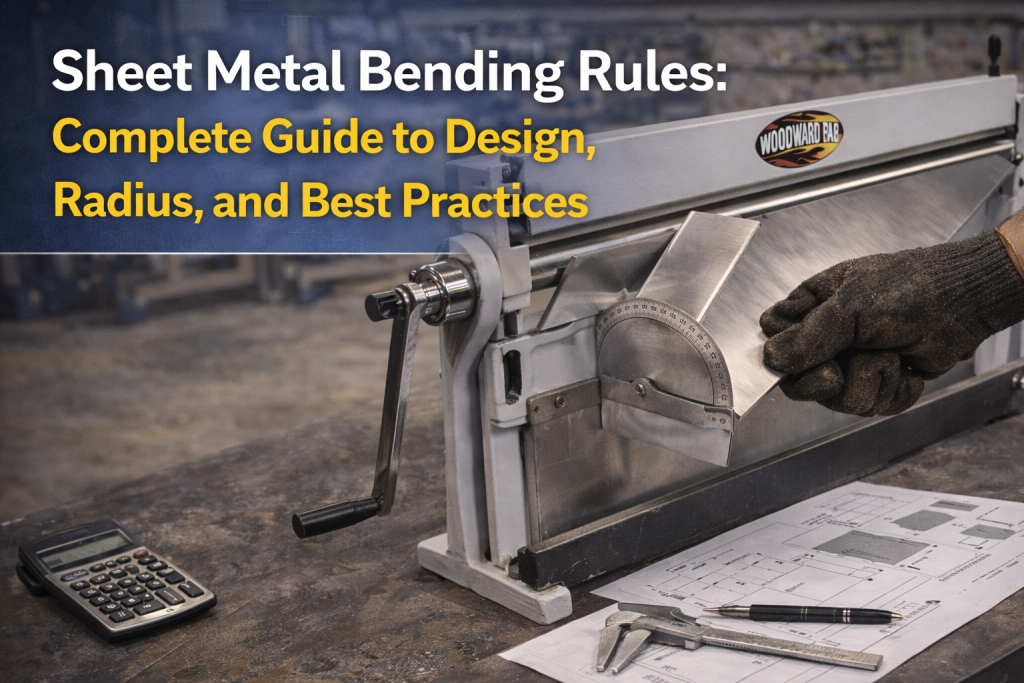
Sheet metal bending is a critical process in manufacturing, used across industries like automotive, construction, aerospace, and custom fabrication. However, achieving precise bends without defects requires a strong understanding of design rules, material behavior, and bending techniques.
This comprehensive guide covers sheet metal design for manufacturability, bend radius guidelines, engineering principles, and essential bending rules to help you improve quality and reduce production costs.
Sheet Metal Design for Manufacturability (DFM)
Design for manufacturability ensures that your sheet metal parts are easy and cost-effective to produce.
Key DFM Principles:
- Keep designs simple and avoid unnecessary bends
- Use standard tooling sizes and bend radii
- Maintain consistent material thickness
- Minimize tight tolerances unless required
- Design parts considering machine limitations
Why it matters:
Poor design increases production time, tooling cost, and error rates.
Sheet Metal Bend Radius Guidelines
The bend radius is one of the most critical factors in sheet metal bending.
| Material | Recommended Minimum Bend Radius | Guideline |
|---|---|---|
| General Standard | 1 × Material Thickness (1T) | Minimum bend radius should be equal to the material thickness. |
| Aluminum | 1T – 1.5T | Suitable for most aluminum alloys to minimize cracking during bending. |
| Mild Steel | 1T – 2T | Recommended range for standard mild steel applications. |
| Stainless Steel | 2T – 3T | Requires a larger bend radius due to higher strength and lower ductility. |
Note: T = Material Thickness. Actual bend radius may vary depending on material grade, temper, thickness, tooling, and manufacturing process. Always verify with your fabrication specifications and tooling capabilities.
Effects of Incorrect Bend Radius:
- Cracking on the outer surface
- Weak structural integrity
- Inconsistent bends
An Engineer’s Guide to Sheet Metal Bending
From an engineering perspective, bending involves controlling material deformation.
Key Concepts:
- Neutral axis (no compression or tension zone)
- Outer surface stretches, inner compresses
- Material properties affect bend behavior
Important Calculations:
- Bend Allowance (BA)
- Bend Deduction (BD)
- K-Factor
These calculations ensure your flat pattern converts accurately into the final bent shape.
Plastic vs Sheet Metal Bending & Forming Guidelines
Though bending applies to both plastic and metal, the behavior differs significantly.
Sheet Metal:
- High strength and rigidity
- Requires force and precise tooling
- Exhibits springback
Plastic:
- More flexible and less force required
- Higher risk of warping or melting
- Needs temperature control in some cases
Bending Basics: Fundamentals of Metal Bending
Understanding the fundamentals is essential before applying advanced rules.
Basic Process:
- Apply force using a press brake
- Deform metal along a straight axis
- Achieve desired angle and shape
Key Factors:
- Material type
- Thickness
- Tooling (die and punch)
- Bend angle
Sheet Metal Bending: The Basics
Here are the foundational rules every beginner should know:
- Always calculate bend allowance
- Avoid sharp internal corners
- Use consistent bend directions
- Account for springback
Sheet Metal Bending Design Tips
Practical Tips:
- Use fewer bends to reduce cost
- Maintain uniform bend orientation
- Add bend reliefs near edges
- Avoid overlapping bends
- Ensure adequate flange length
Guidelines for Bending
General Rules:
- Minimum flange length ≥ 4× thickness
- Hole-to-bend distance ≥ 2× thickness
- Keep bends away from edges
- Avoid bending across cutouts
Metal Bending Design Rules
Core Rules to Follow:
- Maintain proper bend radius
- Use correct K-factor values (0.3–0.5 typical)
- Allow for springback compensation
- Follow grain direction guidelines
Advanced Sheet Metal Bending Rules
| Rule | Best Practice | Purpose |
|---|---|---|
| Grain Direction Consideration | Bend perpendicular to the material grain whenever possible. | Reduces the risk of cracking and improves bend quality. |
| Springback Control | Slightly overbend the part and use precise tooling. | Compensates for material springback to achieve accurate bend angles. |
| Tolerance Management | Consider variations in material thickness, tooling, and manufacturing processes. | Ensures dimensional accuracy and consistent part quality. |
| Tool Selection | Choose the correct die width and punch radius based on the material and thickness. | Improves bend precision, minimizes defects, and extends tool life. |
Common Sheet Metal Bending Methods
Air Bending
- Most widely used
- Flexible and cost-effective
Bottoming
- More accurate
- Requires more force
Coining
- High precision
- Permanent deformation
Common Mistakes to Avoid
- Ignoring bend allowance
- Using too small bend radius
- Poor hole placement
- Not considering material grain
- Skipping prototype testing
Real-World Applications
Sheet metal bending is widely used in:
- Automotive panels
- HVAC systems
- Electrical enclosures
- Furniture manufacturing
- Aerospace components
Pro Tips for Better Results
- Use CAD software for simulation
- Prototype before mass production
- Standardize materials and processes
- Work with experienced fabricators
Conclusion
Understanding and applying sheet metal bending rules is essential for producing high-quality, durable, and cost-effective components. By focusing on design for manufacturability, correct bend radius, proper calculations, and best practices, you can significantly improve your fabrication outcomes.
Whether you’re an engineer, designer, or manufacturer, mastering these principles will help you avoid costly mistakes and achieve consistent results.

Related Post:
- How to Read a Sheet Metal Gauge Chart: Gauge, Thickness & Material Explained
- Why Does Sheet Metal Crack When Bending? Causes and Solutions
- Manual vs Hydraulic Press: Which Metal Fabrication Press Do You Need?
- Sheet Metal Holders: Types, Benefits, Applications, and Buying Guide
- Sheet Metal Bending & K-Factor Calculations: A Comprehensive Guide