
Understanding sheet metal thickness is essential when selecting material for fabrication, repair, bending, cutting, or forming. A sheet metal gauge chart provides a convenient way to understand the relationship between a metal’s gauge number and its actual thickness.
However, gauge numbers can be confusing because a lower gauge number generally means thicker metal, while a higher gauge number means thinner metal.
For example, 18-gauge steel is thicker than 20-gauge steel. The actual thickness represented by each gauge can also vary depending on the type of metal. Understanding these differences helps fabricators choose the appropriate material and avoid errors during fabrication.
In this guide, we’ll explain how to read a sheet metal gauge chart, convert gauge to thickness, understand material differences, and determine which thickness may be suitable for a project.
What Is a Sheet Metal Gauge?
A sheet metal gauge is a numbering system traditionally used to identify the thickness of sheet metal. Instead of specifying a material only by its thickness in inches or millimeters, fabricators can refer to it by its gauge.
Lower gauge number = thicker sheet metal
Higher gauge number = thinner sheet metal
For example, 16-gauge material is thicker than 18-gauge material, while 22-gauge material is thinner than 20-gauge material.
Gauge numbers are commonly used when purchasing sheet metal, identifying existing material, selecting fabrication tools, and communicating material requirements.
However, gauge is not a universal measurement. The thickness associated with a particular gauge can differ depending on the material, which is why a material-specific metal gauge thickness chart should be used when accuracy is important.
How to Read a Sheet Metal Gauge Chart
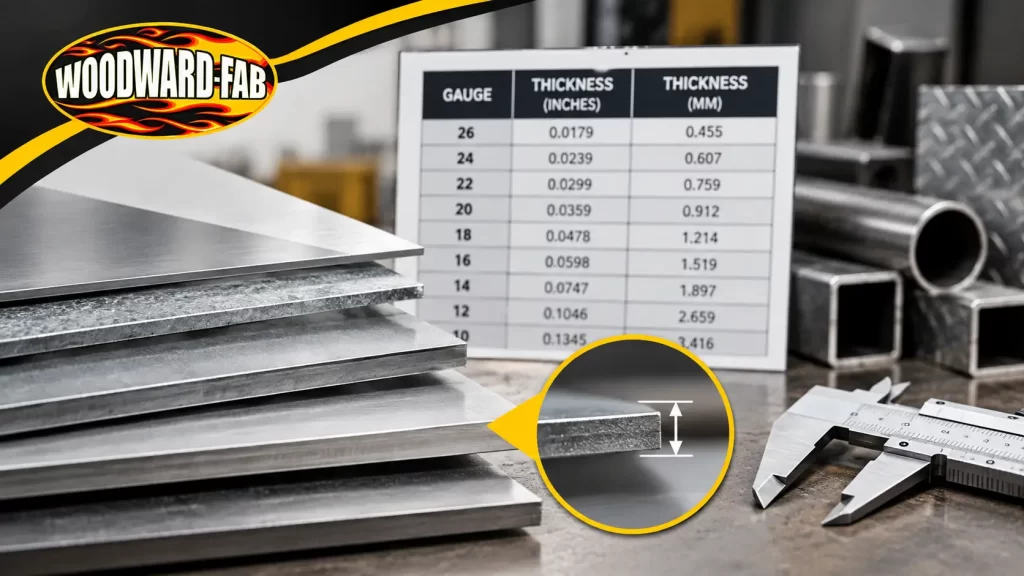
A typical sheet metal gauge chart includes the gauge number along with its approximate thickness in inches and millimeters.
| Steel Gauge | Approx. Thickness (inches) | Approx. Thickness (mm) |
|---|---|---|
| 24 | 0.023″ | 0.58 mm |
| 22 | 0.029″ | 0.73 mm |
| 20 | 0.036″ | 0.91 mm |
| 18 | 0.048″ | 1.22 mm |
| 16 | 0.060″ | 1.52 mm |
| 14 | 0.075″ | 1.90 mm |
| 12 | 0.105″ | 2.66 mm |
| 10 | 0.135″ | 3.43 mm |
These values are approximate and are provided as a general steel reference. Always check the appropriate material-specific specification when exact dimensions are required.
When reading the chart, start by identifying the gauge number. Then move across the row to find the corresponding thickness in inches or millimeters.
For example, if you’re working with 18-gauge steel, the chart indicates an approximate thickness of 0.048 inches or 1.22 mm.
Why Does Gauge Thickness Vary by Material?
One of the most important points when using a sheet metal thickness chart is that gauge numbers do not necessarily represent the same thickness across different materials.
Steel, stainless steel, and aluminum can use different gauge-to-thickness relationships. As a result, an 18-gauge aluminum sheet should not automatically be assumed to have the exact same thickness as an 18-gauge steel sheet.
This is why material identification should come before selecting a gauge conversion.
When Selecting Sheet Metal, Consider:
- Material type
- Gauge
- Actual thickness
- Material grade, where applicable
- Required strength and formability
- Fabrication process
For precision work, drawings and material specifications should generally state the required thickness rather than relying on gauge alone.
Gauge vs. Actual Sheet Metal Thickness
Gauge and thickness are related, but they are not the same thing.
Gauge is a numbering system, while thickness is a physical measurement expressed in units such as inches or millimeters.
18 gauge steel = 0.048 inch = 1.22 mm
The gauge gives you a convenient reference, while the thickness tells you the actual dimension.
This distinction becomes particularly important when working with fabrication equipment. Bending, cutting, forming, and welding processes depend on the material’s actual thickness and properties.
If a project specification calls for a particular thickness, use the specified measurement rather than assuming that a gauge number will always provide an exact equivalent.
How to Measure Sheet Metal Thickness
If you have an existing piece of sheet metal and don’t know its gauge, measuring its thickness can help you determine the appropriate gauge range.
A sheet metal thickness gauge is designed specifically for this type of measurement. These tools typically have openings or measurement points corresponding to different gauge numbers and thicknesses.
How to Measure Sheet Metal
- Clean the area being measured.
- Place the sheet metal thickness gauge against the material.
- Ensure the material is properly positioned in the gauge.
- Identify the point where the material fits correctly.
- Read the corresponding gauge and thickness.
- Compare the measurement with the appropriate material chart.
Woodward Fab offers a sheet metal thickness gauge designed to help identify sheet metal thickness and gauge, making it useful when working with existing or unidentified material.
For critical applications, a precision measuring instrument such as a micrometer or caliper may also be used to determine the actual thickness.
Why Sheet Metal Thickness Matters in Fabrication
The thickness of sheet metal affects how the material behaves during fabrication and how the finished component performs.
Cutting
Thicker materials generally require equipment with greater cutting capacity. Before cutting, verify that your shear, cutter, or other equipment is suitable for the selected material and thickness.
Bending
Sheet thickness affects the force required to bend metal and can influence the bend radius and finished dimensions. Your sheet metal brake or bending equipment should be appropriate for the material and thickness.
Welding
Thin sheet metal can be more susceptible to burn-through and heat distortion. Welding settings and techniques may need to be adjusted according to the material and thickness.
Forming
Thickness also influences how easily sheet metal can be shaped. The material’s thickness, strength, and ductility all play a role in forming operations.
Choosing the appropriate thickness therefore involves more than simply selecting a gauge number. The intended application and fabrication process should also be considered.
How to Choose the Right Sheet Metal Gauge
There isn’t one sheet metal gauge that works for every project. The appropriate thickness depends on what you’re making and how the material will be fabricated.
1. Consider the Application
Start by determining how the finished component will be used. Decorative panels, brackets, body panels, enclosures, and structural components may require different thicknesses.
2. Consider Strength Requirements
If the component needs greater rigidity or resistance to deformation, a thicker material may be appropriate. Lightweight applications may require thinner sheet metal.
3. Consider Formability
If the material needs to be bent, rolled, or shaped, make sure the selected thickness and material are suitable for the forming process.
4. Check Your Equipment
Your fabrication equipment has specific capacity limits. Confirm that the selected gauge and material can be safely processed using your tools.
5. Verify the Material
Always identify whether you’re working with steel, stainless steel, aluminum, or another material before using a gauge conversion chart.
Common Mistakes When Using a Gauge Chart
A few simple mistakes can lead to incorrect material selection.
Assuming a higher gauge means thicker metal: Remember that, generally, a higher gauge number indicates thinner sheet metal.
Using one chart for every material: Gauge-to-thickness conversions can vary by material, so use the correct chart.
Choosing material based only on gauge: Consider strength, application, formability, and fabrication requirements as well.
Ignoring actual thickness: For precision work, verify the required thickness in inches or millimeters.
Final Thoughts
Learning how to use a sheet metal gauge chart makes it easier to understand sheet metal specifications and select appropriate materials for fabrication projects. The basic rule is simple: lower gauge numbers generally indicate thicker material, while higher gauge numbers indicate thinner material.
However, gauge should always be considered alongside the type of material being used. Steel, aluminum, stainless steel, and other metals can have different gauge-to-thickness relationships.
When accuracy matters, verify the actual thickness using a suitable measuring tool and consult the appropriate material specification. With a clear understanding of gauge, thickness, and material, fabricators can make more informed decisions when cutting, bending, forming, and working with sheet metal.
Frequently Asked Questions
Yes. For the same material reference, 18-gauge sheet metal is thicker than 20-gauge sheet metal.
Use a gauge-to-thickness chart specific to the material you’re working with. The chart will typically provide the approximate thickness in inches and millimeters.
Yes. The thickness associated with a particular gauge can vary between materials, so always use the appropriate material-specific gauge chart.
You can use a sheet metal thickness gauge to identify the approximate gauge and thickness of an existing piece of sheet metal. For more precise measurements, a caliper or micrometer can be used.
Need the Right Equipment for Sheet Metal Fabrication?
Explore Woodward Fab’s range of sheet metal fabrication equipment for cutting, bending, forming, and shaping metal.
Explore Sheet Metal Equipment
Related Post:
- Metalworking Tool Selection Guide: Match the Tool to the Fabrication Task
- Sheet Metal Forming Methods: Deep Drawing, Flanging, Hemming & More
- How to Choose the Right Sheet Metal Gauge for Automotive Projects
- Aviation Snips vs Sheet Metal Shears: Which Cutting Tool Should You Use?
- Why Does Sheet Metal Crack When Bending? Causes and Solutions